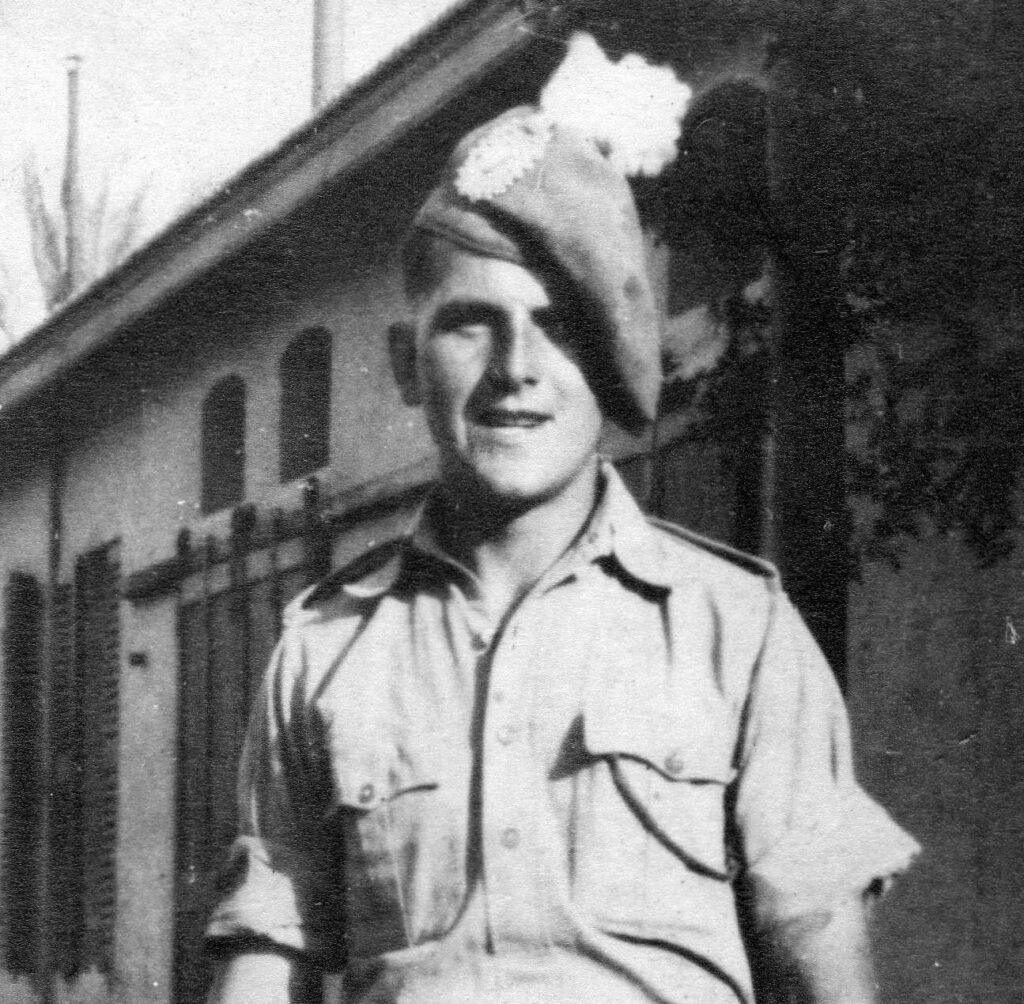
On the afternoon of 1 February 1944, I and several other slightly wounded men were lying around on our beds in the General Hospital in Naples, resting after treatment for injuries received at Monte Damiano near Castelforte. I was wearing a black patch over my right eye, as I had caught some of the blast from the shell-burst that had seriously wounded our company commander, Captain Sir James Henry, when D Company’s Headquarters had received the direct hit.
We were surprised to see Lord (‘Monty’) Stopford walk into the ward. He told me to sign the men out and get down to the harbour, where there would be boats waiting. This appeared to be confirmation of a rumour that was going around at that time, which was that all wounded personnel, even those only slightly injured like ourselves, were going to be sent home.
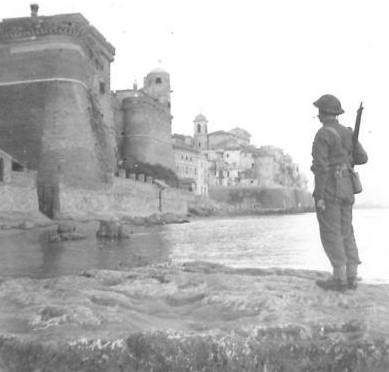
Sure enough, there were the boats waiting for us when we got to the harbour that evening and we duly embarked, only to find that we were not being taken out to a troopship as we had imagined but that the boats were landing-craft and that we were bound for Anzio, a four hour sea-trip along the coast to the south of Rome. The Battalion was considerably under strength at the time and, of course, there really wasn’t much prospect that anyone would be sent home.
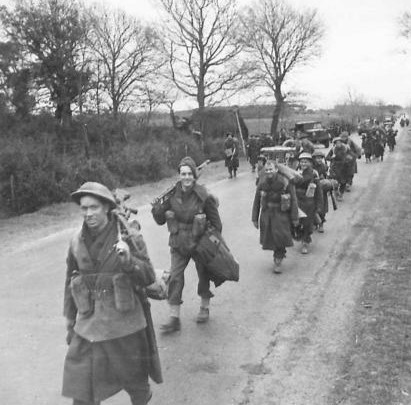
The landing was quick and without trouble and, in no time at all, we found ourselves on the way to the front line positions. I don’t remember the name of the regiment that we relieved but there were certainly far more of them than us to cover the ground. In the early hours of 3 February, our initial position was located by a crossroads but later we advanced a little and D Company dug-in near a farm. In one of the outbuildings, I claimed a large manger for myself, about six feet by two feet, in which to stow my gear and stretcher.
I was in charge of a four man stretcher party and we rapidly became very busy, bandaging the wounded and helping out in general. When we were ready to take our casualties to the Regimental Aid post (R.A.P.), our Company Commander, Major Patrick McMahon Mahon, asked me to escort back four German prisoners that D Company was still sustaining. I set off with my little group, consisting of the four prisoners, some walking wounded and a more severely-injured casualty, whose stretcher the others, including the prisoners, took turns in carrying.
The journey back to the R.A.P., along a narrow dirt track, took us about twenty minutes and, therefore, must have been about a mile or so. We encountered nobody on route and, by and large, it was uneventful. After handing the prisoners over to Intelligence and seeing my casualties settled in, I came across Drummer Downer (better known as “Guv’nor”) and Piper Hughes.
Needless to say, we were soon indulging ourselves in a brew-up, over which they told me the latest news, which was that D Company was getting stonk-ed. I was glad of the break but, in these circumstances, it had to be rather a short one as I had to get back as quickly as possible. Fortunately, my return journey along the dirt track was uneventful but, when I reached D Company’s advance position, I found that things there had been anything but un-eventful, the farm having suffered several direct hits. I made my way to the out-building where I had based myself and found several of the lads clawing frantically at the bricks and rubble that had fallen on the manger where I had stored my gear.
I tapped one on the shoulder. ”What’s going on?, I enquired. He spun round, his face a picture of astonishment. “Strewth, George”, he said (or words to that effect). “We thought you were buried under this lot!” When one of the other men, hearing my voice, turned to check that he wasn’t imagining things, I saw that it was Patsy Kerr, a fellow piper and stretcher-bearer and that his head was bandaged. “Is that you, George?” he said in amazement, almost in disbelief. I then saw that he had sustained injuries to his eyes – and yet, despite this, he had joined those searching for me under the rubble. Right away, I sought out the Major and suggested that Patsy should be returned to the R.A.P. Permission was readily granted: there was some more casualties to go back anyway and some more prisoners and so once again I found myself escorting an assorted group back to the R.A.P. and down the same mile of dirt track.
After doing all that was necessary and having settled Patsy in, I got back on the track and returned to our position. By this time, things were considerably quieter, the Germans having switched their attention to the Irish Guards who were on our left. There was even an opportunity for another most welcome brew-up and it was during this brief respite that Piper Hutchens came up with the Company’s cigarette and chocolate rations but said he could not leave them without payment. I thought he was joking but he said that regulations were regulations. Fortunately, I had a plentiful supply of army lira in my haversack and so was able to pay him the thirty-odd pounds he required.
The Major said we had better use our rations straight away before Jerry could get to them. How right he was: ten minutes later, we were attacked and stonk-ed again. A call for stretcher bearers rang out. The casualty was Sgt Alf Fry. We gave him first aid when he fell and then put him onto the stretcher to take him back for more comprehensive treatment but he was mortally wounded and we had gone no more than twenty yards when he died. Placing him under cover, we went and reported his death to the Major, who was very upset as he had been an excellent N.C.O., friendly to his men and well-liked by them.
On the afternoon of 8 February, I was asked to take care of a man suffering from a very bad attack of nerves who was upsetting what was left of D Company. The Major told me to settle him down, somewhere away from the other men. Searching around the farm, I found a suitable place – a disused chicken shed, which was one of the few undamaged buildings remaining. I bundled the man in and told him to relax and have a rest and as, by this time I was myself beginning to feel terribly fatigued, and as I thought it might help the man to settle down if I joined him, I said I would stay with him for a bit. I made myself comfortable and closed my eyes. I was very quickly dropping off to sleep when I heard the sound of shells starting to fall and someone rushing past shouting “Hi, Mon!” or so I thought. I was so tired that I could not immediately rouse myself and my sub-conscious supplied a convenient answer – we had been relieved by the London Scottish.
With this reassuring thought, I was just about to lapse into a deeper sleep when instinct prevailed and told me to wake up. I roused my patient, telling him to have a look round outside and find out what was happening. He obeyed my orders and disappeared and I started gathering up my gear. Within a few minutes, there was a knock on the shed door. “Who’s that?” I asked. “I’ve brought someone to see you, Corporal,” said the voice of the man that I had been looking after. The door opens and there stands a German officer pointing a revolver at me. The penny drops. The yell that I had heard must have been a warning shout – “Herman”, or something like that and not a salutation from our brothers-in-arms, the London Scottish.
My rest now shattered, I find myself being marched away as a prisoner! Off we go and, just as we are turning the corner of the building, I walk straight into another German officer coming in the opposite direction – but this German has got his hands up! “What’s going on?” asked a voice behind him in English. “There’s a German officer behind me with a revolver in my back,” I replied. “Well, he’s had it,” was the rejoinder, “because we’ve captured most of his lot!” So, the tables were turned and the German behind me had to give himself up.
We carried on round the corner of the building – and a scene met my eyes that was unbelievable. At one and the same time, in the same place, there were our lads with Germans as prisoners while only a few yards away stood other British troops, who were in the process of being taken prisoner. This chaos lasted for a few minutes until someone blew a whistle and our boys took over the lot. The Germans were herded into a corner of the farmyard and we were just handing out cigarettes to them when we heard the rumble of tanks. Someone said that they were being sent in to help us. Into the farmyard rolled two tanks – two German tanks. You can imagine our surprise. Once again, I became a prisoner.
On the following day, 9 February, we were herded together in the early hours and marched in the dark towards the German lines. We were marched through a minefield and through a barrage that our artillery boys were putting down. Nearly all our German escort were killed or wounded but by some miracle we ourselves got through almost unhurt. On arrival at the German lines, we were taken to an underground room for interrogation, following which I and almost fifty other men of the London Irish were to spend the next fourteen months as prisoners of war.
We were taken on a long march, our destination being Rome, where we were put into a large building, which we found out was a film studio. We were there for only one day and then we were alternately transported and marched on another long journey to Northern Italy – to a place called Latrina where we spent two days.
We were then put in box trucks bound for Germany, ending in Stalag IVB at Muhlberg, roughly eighty odd miles south of Berlin, between Leipzig and Dresden. I received further treatment whilst there and, as a result of ministrations of a Russian doctor, my eye condition got better. During our captivity, we were able to glean quite a lot of news, particularly when a new intake of British prisoners came in and it was in this way that we learned that Colonel Macnamara had been killed.
Of course, it was not until our release that we got all the details of how the Regiment had fared after our abrupt departure – and very good it was to hear the end of the story, since told in so many books and memoirs.