The centre of gravity in the fighting seemed to pass to the Eighth Army front by October 1944. With a little more strength, the Allied Armies might have accomplished more in the attack towards the River Po before the autumn and winter rains set in, but it was revealed by General Alexander afterwards that some American and French Divisions had been withdrawn from Italy for the attack on the south of France and this had weakened his forces. To drive the Germans from the Po Valley during the winter could hardly be expected.
Nevertheless there was work to be done, and when the Irish Brigade returned to Italy they went to Monte Capello, an important height in the mountains between Florence and Bologna and looking down the Po Valley. The weather was most depressing, and for the first part of their stay the battalion had an uneventful time. A turkey farm was started at ‘B’ Echelon, with an eye to the approach of Christmas. The turkeys were supplied by companies that had found birds willing to give themselves up in order to get fat on Army fare! When the 2nd battalion left Monte Capello the farm consisted of twenty turkeys and six fat geese. The London Irish moved to Apollinare on October 19 in readiness for the attacks by the division on Monte la Pieve and Monte Spaduro. Pieve had already fallen and the Royal Irish Fusiliers, who had preceded the London Irish, were on the edge of Spaduro. After a gallant but costly attempt the Faughs had been forced back by heavy counter-attacks, and the London Irish were ordered to have a go.
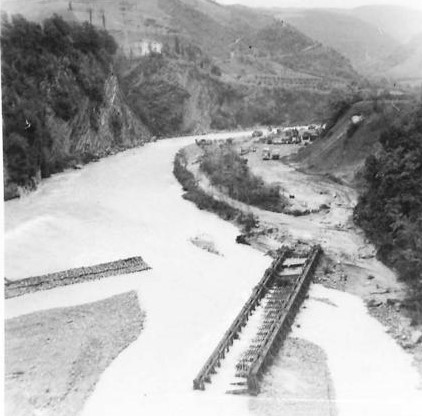
Attacks on Casa Spinello
The Pieve and Gesso Ridges were joined to the lower Spaduro feature by a narrow neck of knobs which fell sharply away on both sides to deep gullies. These knobs were numbered Point 401, Point 416, Spinello Farm, and Point 387. Then came a semicircular chain of knife-edged bumps leading to the main height of Spaduro.
The attack was planned for midnight on October 21-22, with the semicircular chain and Point 287 as the objectives. ‘F’, ‘G’, and ‘H’ Companies went forward with gun support, but unexpectedly heavy fire from Spinello on the right forced them to take cover in a wadi. Their position was seen by the enemy and they were compelled to remain behind the reverse slope all day within a curtain of protective fire from our guns and mortars. A further attack was made in the afternoon with the help of ‘E’ Company, who marched round to take the enemy from the left flank while ‘F’ Company tackled Spinello.
The effort nearly succeeded. ‘H’ Company fought hand-to-hand up the slopes north of Point 387, but lost heavily in a counter-attack. All the officers, except the Company Commander, Major W Craig, were killed, and the platoons had to give up the ground gained. The cross-fire from Spinello still caused trouble, and the strongly entrenched Germans there resisted all the efforts of ‘F’ Company though one officer and a sergeant reached the walls of the farm before being killed. The decision was then made to withdraw H and F Companies to cover behind Point 416. With G Company giving covering fire this was done without more casualties.
It was clear that nothing could be done about Spaduro from that side until Spinello fell. The battalion had now been in the line nineteen days with a break of only one night, and had taken part in two major attacks. For thirty-six hours they had lived on haversack rations. Two of the companies had lost heavily, but Support Company and battalion headquarters had been lucky. Next morning a patrol, consisting of Lieutenant D Fay, MC. Sergeant Farthing, and two riflemen went out to ascertain the strength and positions of the enemy in Spinello. By a most daring feat of arms they captured a German on the outskirts of the farm, and obtained valuable information. Immediately a plan was made for ‘E’ Company to capture the farm area, which they accomplished with fire support. Later, as ‘F’ Company went up to help hold off a counterattack, they passed into a minefield and two officers, Major RW Boyd, MC, and Lieutenant J Bruckmann, and two other ranks were killed. CSM Kelly, DCM, took over the company and the farm area was held.
That same night, other battalions attacked Spaduro from the left flank and the height was finally captured.The London Irish took well-deserved credit for a part of this success because they had distracted the enemy’s attention and drawn most of their fire. The Divisional Commander and the Brigadier emphasised this point in complimenting the battalion later on its work.The London Irish losses were five officers killed (Major RW Boyd, Lieutenant S Thompson, Lieutenant V Bryning, Lieutenant J Bruckmann, and Lieutenant C Cramb. The last two were South African officers seconded to the battalion, One officer, Major Davies, was wounded just as the attack on Spinello was assured. Fourteen other ranks were killed and fifty wounded. Sergeant Farthing unhappily died of wounds.
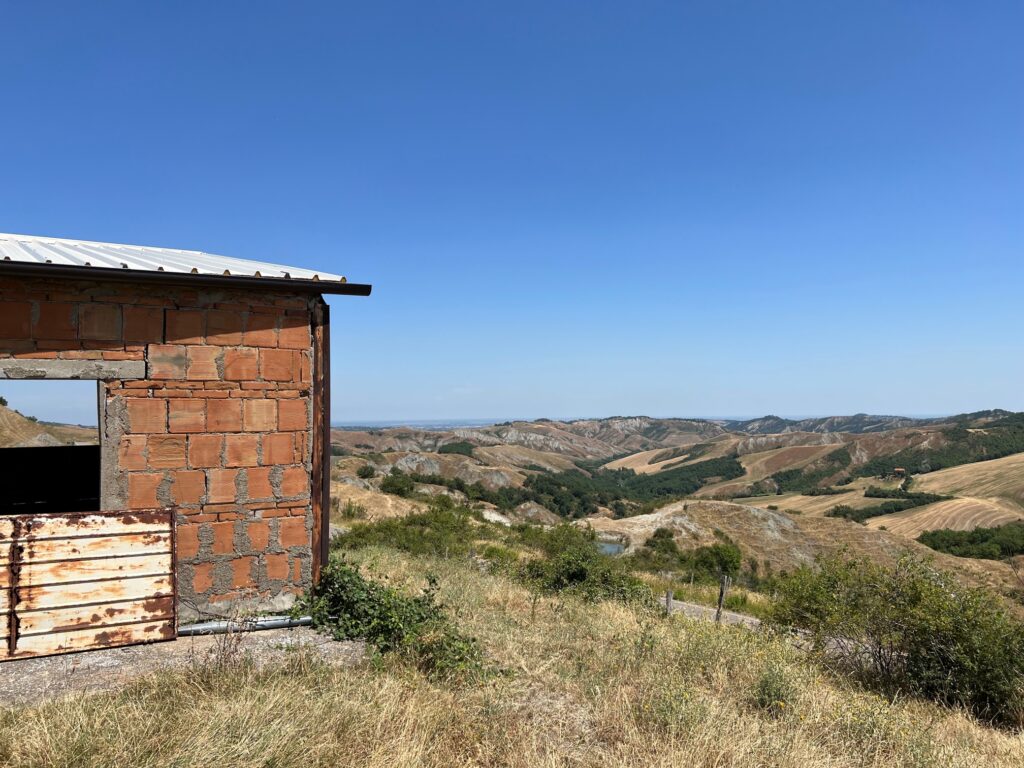
A Veteran Remembers.
Lt. Nicholas Mosley recalled that period:
“When Major Mervyn Davies was summoned by the colonel and the brigadier to report on his withdrawal, he said that they did not seem to understand the futility of their tactics: we would never take Spinello – nor indeed Spaduro – with cumbersome numbers of men sliding down into a mud trap at night and there remaining hopeless, while they were shot at from Spinello.
What was necessary, he said, was for a small force of men to set off while it was still lightly held, by as direct a route as possible to Spinello, and keeping as far as they could just under the shelter of the spur. Then, when they were as close to Spinello as they could get like this, they could attack, running fast across open ground. This should happen shortly before the regular time of ‘stand to’ at dusk, when it was almost inconceivable that the Germans would be expecting an attack, so uncommon was any movement by day and, in fact, it was possible that the Germans would be sleeping. Then, if this attack on Spinello was successful, there would be a chance of a major night attack on Spaduro succeeding.
The colonel and the brigadier listened to Mervyn and said: ‘All right, you and your company try it.’
One of the other platoon commanders in our company was the young communist from Liverpool, Desmond Fay, with whom, in Egypt, I had argued amicably about communism and fascism. Desmond had been brave during the advance from Cassino and had been awarded the Military Cross.
Now, when Mervyn gathered us together to tell us of his plans – he suggested that Desmond should go out in the early afternoon with just one or two men and try to find out what was the situation in Spinello and how many Germans were there and what were their defensive positions. If possible, he should bring back a prisoner, who could be questioned. Then, if Desmond’s information was satisfactory, I, with my platoons, would lead an attack to capture the farmhouse and buildings – still in daylight, but just before the time when the Germans could be expected to be standing to. If my attack was successful, the rest of the company would come up and we would hold Spinello during the night while the inevitable German counter attacks came in and, while a large scale Allied attack on Spaduro would go in, this time with a chance of success.“