At 1235hrs on 1 December, 6 Innisks held the area 360 and the Brigade Commander ordered the Bttn to seize and hold the bridge at 368075. Two coys, G and E, were therefore ordered across country, the remainder of the Bttn moving into Rocca, less H Coy, which remained in Fossacesia.
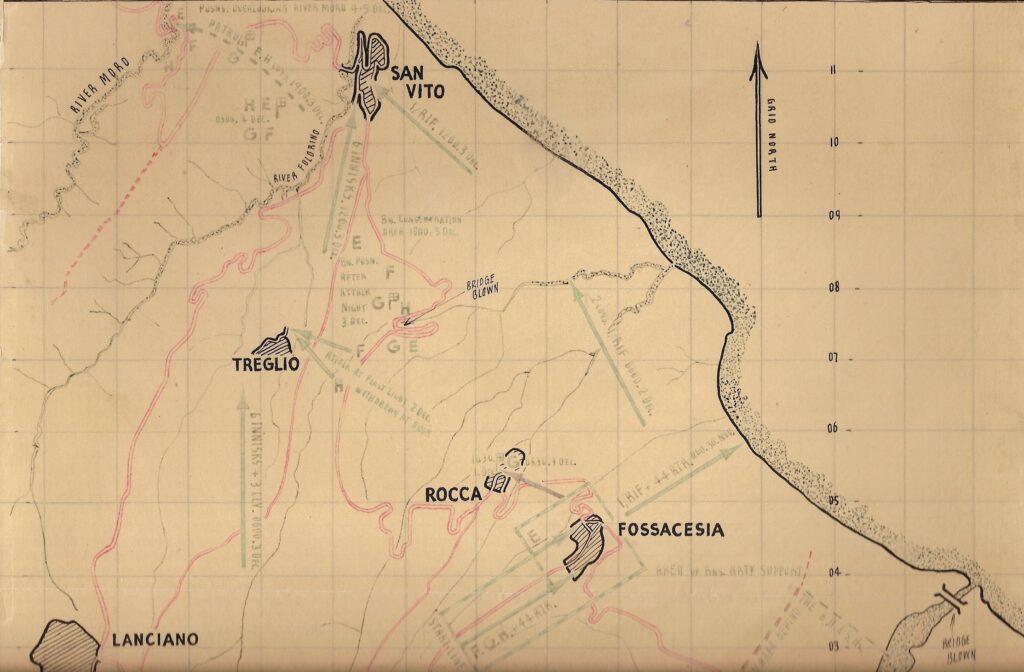
By 1630hrs, G and E Coys were in the general area 365070 when enemy opposition was met. Patrols were sent out to find routes across the ravine, which was deep and narrow with precipitous sides both in front and for a considerable distance to both flanks. By this time, a squadron of 44 RTR had come forward in support; and F Coy, which had been ordered forward some time previously, had also arrived and was in the area 362067.
The Brigade Commander ordered that the ravine must be crossed and a bridgehead established to cover the repair of the bridge if not before first light then as soon after as possible. Full artillery support being available on call. Until the bridge was repaired no tanks or supporting arms could get across unless man handled. Support would have to be given by both from the rear side of the obstacle.
It was thought that the right flank offered the best chance of approach in the area 367077, the bridgehead being cleared and established from the right. Plans were made accordingly. At 0200hrs on 2nd December, a patrol returned with the information that the approaches on the right were not possible. The plan was therefore changed and it was decided to force the ravine about 360067, and establish the bridgehead from the left. During the night, H Coy moved forward to the area 363067.
At first light on 2nd December, F and H Coys crossed the ravine to secure the high ground east of Treglio (3507). After advancing approximately 300 yards on the far bank, they were held up by heavy automatic and mortar fire, and were unable to get further forward. Throughout the day, all attempts to advance were held up despite assistance from tanks (from the rear bank firing across the ravine and from 3“ mortars and MMGs. Several determined enemy counter attacks were beaten off and the coys were successful in holding the ground already won. One disadvantage that seriously hampered the coys’ efforts was the fact that the supporting artillery was firing at maximum range and so accurate support was not available from them.
In the evening, news was received that a combined infantry and tank attack was to take place at first light along the road Lanciano (3203) – Treglio (3507) – San Vito (3611). F and H Coys were therefore withdrawn during the night to avoid them becoming involved in this attack. Patrols only being left across the ravine to keep contact and harass the enemy.
During the night 2/3 December, a ‘Chinese’ attack was made in the bridge area 368075 with 3“ mortars , MMGs etc. This caused considerable enemy fire. At dawn on 3 December in conjunction with the tank and infantry attack from Lanciano towards Treglio, G and E Coys crossed the ravine in the bridge area and made a bridgehead. F Coy followed leaving H Coy and Bttn HQ on the rear side of the ravine.
The Bttn was then disposed as follows:
G Coy – area 368076.
F Coy – area 372080.
E Coy – area 375083.
H Coy – area 370072.
Bttn HQ at 370073.
Here the Bttn remained till the afternoon while the bridge was being repaired. At 1500hrs, the Bttn was relieved by a Canadian Bttn and it then concentrated forward south of San Vito (3611) in the area 362097.
The orders were to move forward and establish one coy as early as possible during the night to the high ground to the west, about 380105. Using this company as a base to patrol with a second coy to the river Moro and gain information about the bridge 337017 and the crossings of the river north and south of it. If possible, to establish the whole Bttn on the high ground during the night – a squadron of tanks to join the Bttn at first light on 4 December.
At 1900hrs, E Coy moved forward to establish themselves on the high ground and by 2200hrs reported themselves in position – though considerable enemy movement was heard. E Coy was ordered to be very aggressive and H Coy was ordered forward to contact E Coy and patrol to the river. By 0100hrs 4 December, H Coy was patrolling and reported enemy between 350105 and the river.
At 0100hrs, G Coy and a command post moved forward and by 0300hrs had joined E and H Coys and established themselves. There were a considerable number of enemy, who had remained undetected during the night in the area and at first light, the task of clearing them out began. At 0700hrs, the squadron of tanks arrived to assist.
At 0600hrs, F Coy and Bttn HQ were ordered forward. As the task of clearing the area went on, coys were established on the high ground overlooking the river as follows:
G Coy – area 337099.
H Coy – area 341113.
E Coy – area 347105.
Considerable trouble was experienced from the right flank, which was fairly strongly held and where the ground favoured the defence. During the afternoon, F Coy, assisted by tanks, cleared the area and was established in the area 344117. During the day, 3” mortars and MMGs were brought forward on mules as the diversion was unsuitable for vehicles.
The bridge, which was not blown when the first troops arrived, was demolished by the enemy about 1400hrs. The positions were under considerable mortar and artillery fire throughout the day but by evening, although very tired , the Bttn was firmly established overlooking and commanding the River Moro. E Coy had been moved up to the area 339017 and G Coy, on relief by two coys of 6 Innisks, had been withdrawn to the area 346105.
At nightfall on 4 December, the Bttn was therefore disposed as follows:
E Coy – area 339017.
H Coy – area 341113.
F Coy – area 347115.
G Coy – area 346105.
and Bttn HQ.
During the night, 4/5 December recce patrols were sent out to discover the depth and width of the river north and south of the bridge. The night was quiet.
On 5 December, orders were received that the Bttn would be relieved by a Canadian Bttn and the Bttn was to move back and take up a position in the area of the bridge 368075 – the positions it had held two days previously.
By 1930hrs, the relief was completed without incident and by midnight the Bttn was in its new area. Here, it remained for just over 24 hours and at 0800hrs began its move back to the rest area near to Campobasso.