This is the title given to the battle in which the German winter line was broken. The river had, in fact, been crossed and the bridgehead established by 11 and 36 Brigades. It was from this bridgehead that the attack was launched. For the operation, the Bttn had trained with 44 RTR and, in fact, on 20 November, had moved forward, carried on tanks, from Cassalbordino. The operation, as originally intended, should have begun on 21 November but wet weather necessitated it being postponed.
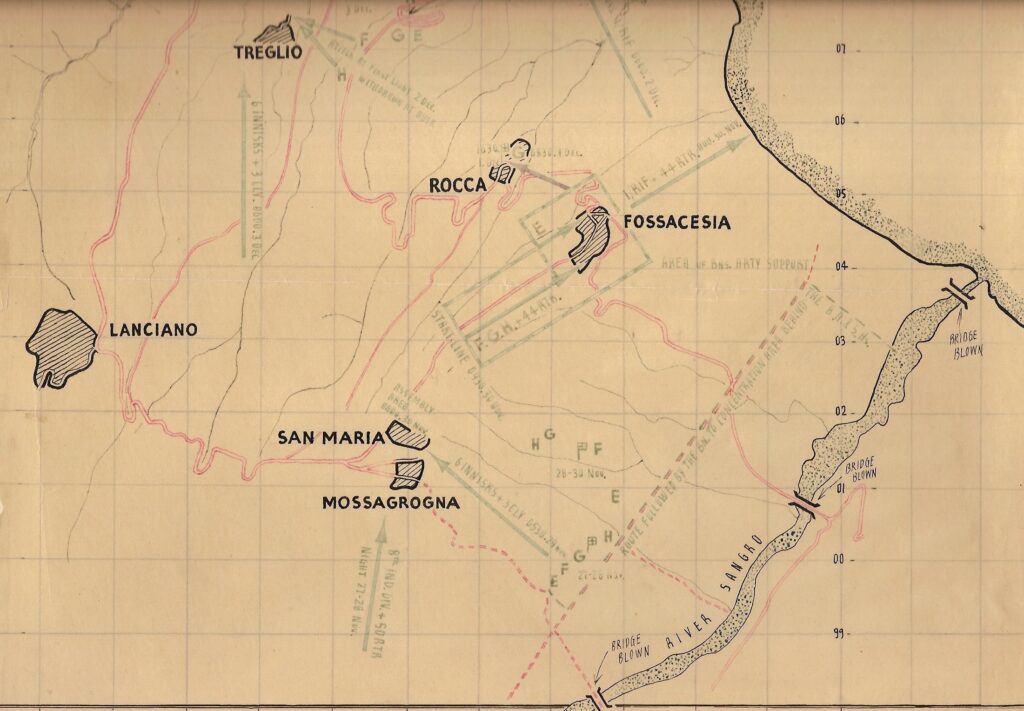
At 1830hrs on 27 November, the Bttn left Cassalbordino carried in motor transport and after debussing east of the River Sangro moved across the river to a lying up area under the escarpment about 402008. This was reached by 0230hrs on 28 November. Here the Bttn married up with S Coy and 44 RTR, who had already moved across two days previously.
8 Indian Division had attacked Mozzagrogna (3600) and San Maria (3601) during the night 27/28 November. Had this attack gone according to plan, the 6 Innisks were to have captured the R Li Colli feature (3702) early on 28th November and been followed by 2 LIR in support of 44 RTR, who were to form up astride the road San Maria-Fossacesia. From this position, the defences on the Fossacesia Ridge were to be rolled up.
The attack by 8 Indian Division was unsuccessful and the situation in the Mozzagrogna – San Maria area was very confused all day on 28 November. It was, therefore, decided that the Irish Brigade and 4 Armoured Brigade (less one Bttn) would capture San Maria and R Li Colli on the morning of 29 November and then roll up the enemy defences from San Maria to the sea.
The outline plan was as follows:
Phase I
At dawn, 6 Innisks, supported by 3 County of London Yeomanry (3 CLY) were to capture R Li Colli and San Maria. 8 A & SH to take over the defence of San Maria after its capture. While this was in progress, 44 RTR and 2 LIR were to move up ready to carry out Phase II of the plan.
Phase II
As soon as Phase I was completed, 44 RTR, supported by 2 LIR, were to move through 6 Innisks and form up astride the road San Maria – Fossacesia. They were to roll up enemy defences up to and including Fossacesia.
Phase III
After a short pause, 44 RTR, supported by 1 RIrF, were to roll up the enemy defences from excluding Fossacesia to the sea.
All these phases were to have full artillery support.
The first phase of the attack went in at dawn on 29 November – the opposition was strong and the ground difficult for tanks. This made the going slow and it was nearly dark before this phase was finally completed. Early in the morning, the Bttn and 44 RTR had moved forward to the area 393015 as planned.
At 1630hrs, the Brigade Commander ordered Phase II to put into operation next morning. Zero hour being provisionally fixed for 0830hrs on 30 November.
As the going across country to the start line was difficult for tanks, it was decided that 44 RTR should go round via the road through Mozzagrogna, which 8 Indian Division had now secured, and San Maria to the start line.
The plan for the attack was as follows:
The lines of enemy defences were divided into seven blocks each 800 yards deep by 400 yards long. All available artillery, having dwelt on the opening line for 30 minutes, was to be concentrated for 10 minutes on each block in turn. At the end of 10 minutes, the artillery lifted from block 1 to block 2. At the end of 20 minutes from block 2 to block 3 and so on.
As soon as the artillery lifted from one block, a squadron and one company of infantry entered it and dealt with the opposition. The coys and squadrons are shown in the sketch.
Blocks 5,6,and 7 were 200 yards deeper (1000 yards in all) in order to include the village of Fossacesia in the fire plan.
Squadrons and companies worked together as follows:
A Squadron and F Coy.
B Squadron and H Coy.
C Squadron and G Coy.
E Coy were not working with any particular squadron but was kept in reserve during the first stages and available to clear the northern part of Fossacesia, of required.
The artillery opening line was 384030 – 379036 and during the 30 minutes from Z to Z + 30, the tanks and infantry moved up as close to it as possible ready to move rapidly forward when the artillery lifted from block 1 to block 2.
The decision to send 44 RTR round by road to the start line necessitated some slight alteration in the preliminary moves. G Coy, being the first coy to go into action with C Squadron, was sent with the tanks and travelled on them to the start line. They left with 44 RTR at 1800hrs on 29 November. The remainder of the Bttn, less S Coy, moved forward to the area 372019 at 0330hrs on 30 November, here to await the arrival of 44 RTR and to marry up with them.
The IO was sent to San Maria with a wireless set to warn the Bttn of the arrival of 44 RTR and as he gave warning of their approach, the coys moved forward and joined them. Except for the fact that 44 RTR were delayed on route by an enemy counter attack on 8 Indian Division, thus necessitating zero hour being put back an hour to 0930hrs, the preliminary moves were completed without difficulty.
The attack was completely successful and by 1300hrs, the ridge and Fossacesia village had been cleared. The artillery concentrations had demoralised the enemy and this, coupled with the appearance of tanks and infantry from a completely unexpected direction, finished them off. Their Defensive Fire task was all prepared for a frontal assault and, when put down, was many hundreds of yards from our troops. Much material and many prisoners were captured at a cost of only two killed and eight wounded.
By 1400hrs, the coys were disposed for the defence of the village of Fossacesia was follows:
F Coy – area 388042.
H Coy – area 394044.
E Coy – area 396048.
G Coy – area 396043.
Bttn HQ – area 395041.
During the afternoon, E Coy sent out a patrol, which found the bridges on the road between Fossacesia and Rocca intact. As a result, G Coy was ordered to move forward at 1700hrs to seize and protect the bridges against demolition. In addition, he reported that the enemy was still in the village of Rocca (3805).
About 2300hrs, orders were issued by the Brigade Commander that active patrolling was to take place into Rocca during the night and the village was to be occupied by G Coy, of clear. If G Coy had not occupied the town by first light, then at 0830hrs on 1 December, the coy, supported by one squadron from 44 RTR, were to seize the village after a preliminary artillery bombardment lasting half an hour.
During the night, patrols reported the village still held but by 0730hrs 1 December, it was apparent that the enemy were leaving. The artillery bombardment was therefore called off and, by 0800hrs, G Coy were established in the village.
The Bttn was now disposed as follows:
G Coy – Rocca 3805.
F Coy – area 388042.
H Coy – area 394044.
E Coy – area 396048.
Bttn Coy at 395041.
The latter four all at Fossacesia.