My last attempt to describe the Battalion’s activities in Italy prior to Christmas 1943 met with a certain amount of criticism from some of my companions on the count that I had passed off the hard-fought battles in a rather light-hearted manner. This was far from the intention but were I to go into frightful details of each of the Battalion’s actions, more time and space would be required.
One of the necessary assets for an infantryman is his ability to look back on his last battled and pick out only the amusing incidents – and it is remarkable what can be laughed at afterwards ! If he were not able to do this, there would be marked decrease in the number of chaps on the start line for the next battle. Having made my explanation, I shall now launch into my narrative.
After our excellent Christmas festivities, we were ordered into the line in the Rionero-Castel di Sangro sector.
So, on New Year’s Eve – of all nights – the Battalion set off through Isernia on a steady climb up to Rionero. Halfway there, it started to snow, lightly at first, but increasing in intensity until there was no doubt that it intended to become a veritable blizzard. Two miles short of Rionero, the vehicles jammed and the Battalion completed its relief by foot, less cooks and supporting arms, the latter assets being taken over from the outgoing Unit.
This was an administrative problem of the highest order, but did not display our already battle and weather-tested “Q” staff, who eventually adjusted the situation some days later together with “S” Company, who exchanged their Mortars and M.M.G.s for those of the previous Unit. After a deal of hard work by all ranks working under Captain J.D. Broadbent.
I feel that I have given the impression that this relief was by now complete. Far from it. I have skipped too hurriedly from the night 31st/1st, which will be remembered by the Battalion as long as any action against the enemy. Words could not give apt description to the hardships of ‘B’ and ‘D’ Companies, Major Franklyn-Vaile and Major J.S. Clarke MC, who relieved the Regiment at Castel di Sangro.
The road was snowed up and the route was a question of trial and error in the face of the worst blizzard that the average Irishman or Englishman has ever faced. Some mention too, I think. Must be made of our newly joined South African officers, whose first experience of snow was so rudely thrust upon them!
‘C’ Company, under Major G.L. Richards MM. will also have good cause to remember the manly efforts at relieving what was known of the “bifurcation Platoon”, and ‘A’ Company, Major D.R.Y. Dawson may well be proud of their endurance for several nights above the ‘bifurcation’.
Back at base, Battalion HQ was well dug in, of course, but even then, they had to contend with two feet of snow in their rooms, owing to the thoroughness of the destruction of the village by the retreating Bosche.
For the period of the storm, Command Post contained at least two COs, two BMs, two Adjutants, three Signal Officers and two Medical Officers and a motley of other officers, all of whom were present at the inauguration of the “Jolly Fusilier”. This name was regarded as the most suitable appellation for Command Post “whence came all rum issues”, and was all the more applicable owing to the identity of the Unit, whom we were relieving. This name has remained ever since and the “Jolly Fusilier” sign, constructed by Sergeant Cross and his hooligans in the shape of a Shamrock, has graced the door of many a farmhouse, the entrance to many a dug out and the battlements of several castle and manor houses and will continue to do so until it ultimately hangs in its rightful place – the gates of the Barracks in Armagh.
This practically completes the relief, but one other fact must be given to emphasise the conditions under which the Battalion performed on that night. The Companies marched eight miles in the teeth of this Apennine Blizzard in order to get to the outgoing Unit. Sufficed to say that with the storm behind them, the other Battalion (2 Lancs Fusiliers) was unable to leave for two days.
A complete novel could be written about our experiences at Castle di Sangro and Rionero. There was Jimmy Clarke’s constitution – which seems to consist of employing all the best dressed Fascists as gardeners! – there were the Sangro trout which were caught under the protection of a Standing Patrol in order to regale courageous officers who came visiting from Rionero; the said officers ensuring that the trout was ordered before attempting the arduous and dangerous journey; there was the occasion of Pipe Sergeant Whelan playing the Adjutant into ‘B’ Company HQ much to the horror of Lawrie Franklyn-Vaile; and there was Major Chance’s episode with the “Beehives” but, then, that officer was always unfortunate with explosives!
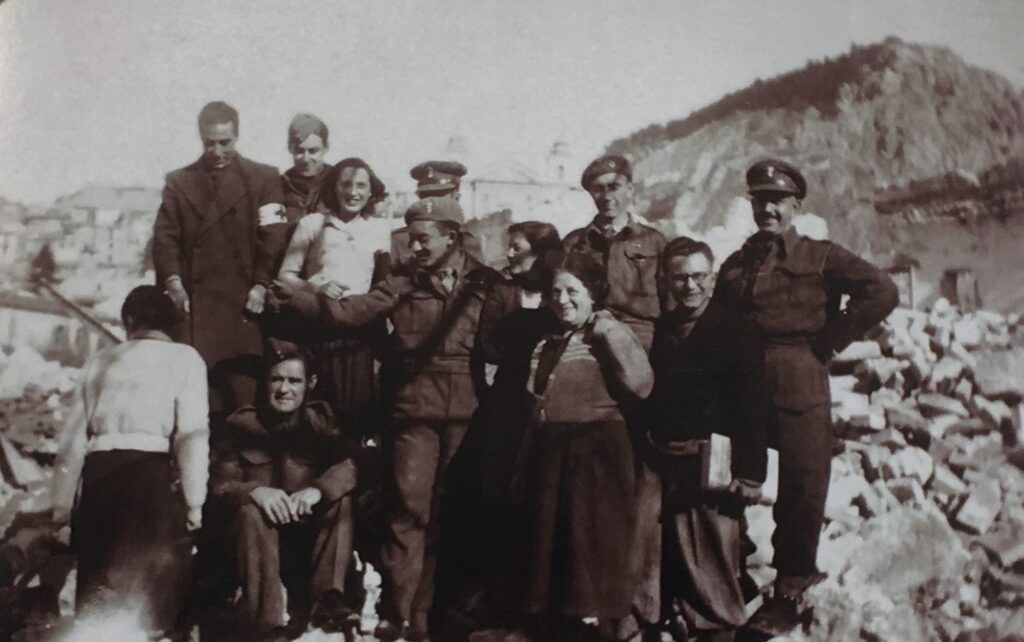
To mention some of the more military activities in this sector, Lieutenant R. Unwin and Lieutenant R. Titterton led some very plucky patrols with a good deal of success; Lieutenant R.S.V. Howard, if memory serves me correctly, accounted for a Kraut or two with his merry lads, and all this was executed at the best possible rate of exchange – we had no battle casualties at all during this month in the line. Shelling and mortaring came our way – it would be a queer war if it didn’t – but we were in the happy position of multiplying by 40 or so, and sending back a suitable answer. This discouraged the German gunners and mortar-men.
So much for what turned out, after an extremely unpleasant opening, to be a comparatively pleasant month’s campaigning. Thence we turned on our tracks and went back to Campobasso for a rest. I say rest but I have often wondered to myself whether a brief stay in a large town can be called rest. All ranks find such a lot to do and I have heard one of the older and more revered Sergeants say that town life was too much for him and that he was looking forward to a rest in the line.
It was at Campobasso that our Pipe Band started to train in earnest and as I write now, I can hear them practising ‘Uncle Dan McCann’. The difference in standard is out of all proportion to the time spent in training and this is due to no small way to the efforts of Drum Major Goldrick, Pipe- Sergeant Whelan and Major H.F.W. Holmes, the latter using some of his many “contacts” to obtain vital spare parts for what were then a rather poor selection of Pipes and Drums. But now they go from strength to strength and when the entire Brigade Band masses, it is a grand sight, of which the “Faughs”, the “Skins” and the “Irish Rifles” are justly proud.
While we were at this place, we were joined by a draft of “Faughs”, which contained many old faces; for example, C.S.M.s Napier and Whitfield, Sergeants (now C.S.M.s) Payne and Taylor and quite a few other well-known N.C.O.s. Some of them regrettably had to go to another Battalion in the Brigade but, nowadays, that is a small misfortune – the Brigade is the parent unit and inter-regimental rivalry has lost all of its unfriendliness. We are proud of our esprit de corps in the Irish Brigade and swear that can be none other like it in the Army.