Christmas 1943 was spent by the 2nd Battalion in the lower Apennines. The battalion was scattered among the mountain villages of Pietra, San Marco, and the town of Campobasso, where they spent the nearest approach to a peace‑time Christmas that was possible.
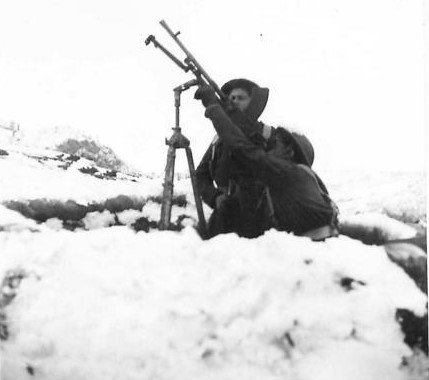
The festive season was short-lived. On December 27 they started a move which eventually brought them into the line again in the hills near Montenero. New Year’s Eve came, and with it a blizzard which those who experienced it will never forget. The snow fell all day, gradually getting thicker and thicker. At 1600 hours G Company came across a German patrol, some forty strong, and a sharp encounter ensued. But visibility was so bad that little could be seen of the effect of the fire or of casualties to the enemy. They eventually retired and disappeared into the blizzard. At night the snow was three to four feet deep, and the next morning permission was given to withdraw the forward companies to Montenero.
In front of the village was a row of mountains, fierce and for-bidding, on an average three thousand to four thousand feet high and extending for some eight miles. Montenero rested in a hollow overlooked on all sides, the country below the mountains being broken by odd spurs and isolated hills thick with Turkish oak. Perimeter defences were formed on the ridge‑tops and supplies were sent up on mules. When snow fell it made life on the hills impossible for more than one night without proper snow‑clothing. Progress was considerably reduced, and while the battalion had to combat new enemies in chills and frost‑bite, the heavy snow cut the supply‑lines, for even mules were unable to get through.
So severe were the conditions that some of the guns up by Rionero were completely covered by snow, and there was no shelling from the Allied side during that short period. It appeared that the Germans suffered similarly.
At length the snow stopped and the weather cleared. There followed a period of vigorous patrolling, with one company occupying a forward hill and another in support on the flank or in the rear. The Germans were entrenched on higher ground-on the far side of the River Sangro, and they frequently sent out patrols to test our strength and positions.
On January 19 they carried out a surprise raid on the forward-platoon areas. The first indication of trouble was some rather un-pleasantly accurate shelling. One shell made a direct hit on 7 Platoon headquarters, and all the section commanders were wounded. Shells also fell along the mule‑track to Montenero and cut the signal lines from company headquarters to battalion headquarters.
The men dived into their slit trenches for cover from the gunfire, and as soon as it stopped 7 and 9 Platoons of E Company were rushed at short range by two parties of Germans, each twenty strong and armed with Schmeissers, rifles, stick grenades, and bayonets. 9 Platoon was completely overrun, and all the men were killed or captured. 7 Platoon had a stiff fight, and in a mix‑up the platoon commander, Lieutenant Mosley, and four other ranks managed to get away. The Germans tried to stop all other movement in the forward‑company areas with well‑laid machine‑gun fire, but a counter‑attack led by Major Davies, Officer Commanding E Company, and Lieutenant Bird, of the reserve platoon, was successful, and the 7 and 9 Platoon areas were cleared. Six of the enemy were killed and one captured.
In this engagement the London Irish had five killed, fifteen wounded, and twenty‑nine missing.
After this, brigade headquarters agreed that the two forward companies should again be withdrawn to Montenero and this was done. By this time some snow‑clothing had been issued to the battalion which enabled the company on counter‑attack duty to lie up all night and keep reasonably warm. But snow blocking the roads held up supplies from time to time, and hard‑scale rations had to be issued. For one day only half‑rations were consumed, but the deficit was made up by roasting two, oxen, the fresh meat of which was a welcome change from “M and V” All through the battalion’s term in Montenero communications were difficult. The wireless sets never worked well in the snow‑covered hills, and signal lines were broken almost once a day, and line parties, well escorted, had to go out. All these small jobs which needed escorts drained the pool of man‑power. It was necessary to keep the troops going at full pressure in order to maintain any measure of security. Added to the rigorous conditions, this made the men really tired.
On the night of January 25 to 26 the battalion was ordered to evacuate Montenero in order that the line might be straightened slightly. What the civilians of Montenero thought when they woke up next morning and found everybody gone will never be known. But it is pretty certain they did not appreciate the heavy shelling the Germans gave the village after the London Irish had left.
In February 1944 the Irish Brigade moved to the Cassino sector which, with its famous monastery and the vast bulk of Monte Cairo towering in the distance, had long held up the Allied advance towards Rome. At this time there were several changes in command. Brigadier TPD Scott, CBE, DSO, who had relinquished command of the 2nd Battalion London Irish Rifles in the previous July on promotion to command 12 Brigade, returned to lead the Irish Brigade. Brigadier Nelson Russell, who had fought with the brigade for nearly eighteen months, had had his health undermined and he was ordered into hospital.
The 2nd Battalion London Irish Rifles was then commanded by Lieut-Colonel Ion Goff, with Major HEN Bredin, DSO MC, as Second-in-Command, but the latter became Commanding Officer of the 6th Battalion Royal Inniskilling Fusiliers, and was succeeded by Major J Coldwell-Horsfall, MC.
An attack on Cassino and the Monastery was impending by the 4th Indian Division and the 2nd New Zealand Division, with the prior support of a colossal air bombardment. This, of course, depended on the weather, and as there was almost constant heavy rain the project was delayed. The role of the Irish Brigade and the rest of the 78th Division was to exploit the break-through when it had been achieved. When St Patrick’s Day came the Irish Brigade were at four hours’ notice to move, but fortunately the Brigadier had made a secret pact with the Divisional Commander that nothing short of a calamity would cause the Irish Brigade to be moved before late on the 18th of March!
The day was observed with traditional ceremonial, and Major-General CF Keightley, CB, OBE, the Divisional Commander, sent a message to all ranks in which he said: ” If the whole Army fights with the same spirit and gallantry with which you have done in the past year, then the Bosche will soon be exterminated. I am confident that next St. Patrick’s Day will see this extermination complete and your return home with all the honour which will be due to you. In the meantime, let us fit ourselves for our last battles. May they be short and successful.”
The General was not far out in at least one of his prognostications.