There were several changes in personnel in the 2nd Battalion. Lieut-Colonel Bredin, recovered from his wounds, became Commanding Officer of the battalion, Lieut-Colonel Horsfall leaving to command the 1st Royal Irish Fusiliers. Major Colin Gibbs MC, Captain E Bird, Captain JD White MC, and Lieutenant P Giles were among a small party who left to take up appointments as staff instructors at various training establishments. Major-General Keightley left the 78th Division on promotion to command 5th Corps.
The Irish Brigade received a most severe blow when news came that the 6th Battalion of the Royal Inniskilling Fusiliers was to be disbanded. They had played a key part in many battles in North Africa in the dark days of November 1942. Then the battle for Centuripe in Sicily, Termoli, the crossing of the Trigno and the Sangro in Italy had all gained battle honours for the regiment. Their place in the Irish Brigade was taken by the 2nd Battalion of the Inniskillings, and most of the non-commissioned officers and other ranks of the 6th were sent to the other battalions of the brigade as reinforcements.
As the 1st Battalion left Egypt advance parties of the 2nd Battalion arrived. They encamped near Quassassin and followed almost on the heels of the 1st Battalion at Sidi Bishr. They also enjoyed a rest with ample leave. New intakes arrived, and after a short period of training they went back to Italy. New officers joined the 2nd Battalion at Sidi Bishr, including Captain F Cave, and Lieutenants V Bryning, Walsh, EM Salter, and S Thompson.
The centre of gravity in the fighting seemed to pass to the Eighth Army front by October 1944. With a little more strength the Allied Armies might have accomplished more in the attack towards the River Po before the autumn and winter rains set in, but it was revealed by General Alexander afterwards that some American and French Divisions had been withdrawn from Italy for the attack on the south of France and this had weakened his forces. To drive the Germans from the Po Valley during the winter could hardly be expected.
Nevertheless, there was work to be done, and when the Irish Brigade returned to Italy they went to Monte Capello, an important height in the mountains between Florence and Bologna and looking down the Po Valley. The weather was most depressing, and for the first part of their stay the battalion had an uneventful time. A turkey farm was started at B Echelon, with an eye to the approach of Christmas. The turkeys were supplied by companies that had found birds willing to give themselves up in order to get fat on Army fare! When the battalion left Monte Capello the farm consisted of twenty turkeys and six fat geese. The London Irish moved to Apollinare on October 19 in readiness for the attacks by the division on Monte la Pieve and Monte Spaduro. Pieve had already fallen and the Royal Irish Fusiliers, who had preceded the London Irish, were on the edge of Spaduro. After a gallant but costly attempt the Faughs had been forced back by heavy counterattacks, and the London Irish were ordered to have a go.
The Pieve and Gesso Ridges were joined to the lower Spaduro feature by a narrow neck of knobs which fell sharply away on both sides to deep gullies. These knobs were numbered Point 401, Point 416, Spinello Farm, and Point 387. Then came a semicircular chain of knife-edged bumps leading to the main height of Spaduro.
The attack was planned for midnight on October 21-22, with the semi-circular chain and Point 287 as the objectives. F, G, and H Companies went forward with gun support, but unexpectedly heavy fire from Spinello on the right forced them to take cover in a wadi. Their position was seen by the enemy, and they were compelled to remain behind the reverse slope all day within a curtain of protective fire from our guns and mortars. A further attack was made in the afternoon with the help of E Company, who marched round to take the enemy from the left flank while F Company tackled Spinello. The effort nearly succeeded. H Company fought hand-to-hand up the slopes north of Point 387 but lost heavily in a counterattack. All the officers except the Company Commander, Major W Craig, were killed, and the platoons had to give up the ground gained. The crossfire from Spinello still caused trouble, and the strongly entrenched Germans there resisted all the efforts of F Company though one officer and a sergeant reached the walls of the farm before being killed. The decision was then made to withdraw H and F Companies to cover behind Point 416. With G Company giving covering fire this was done without more casualties.
It was clear that nothing could be done about Spaduro from that side until Spinello fell. The battalion had now been in the line nineteen days with a break of only one night and had done two major attacks. For thirty-six hours they had lived on haversack rations. Two of the companies had lost heavily, but Support Company and battalion headquarters had been lucky. Next morning a patrol, consisting of Lieutenant D Fay, MC, Sergeant Farthing, and two riflemen, went out to ascertain the strength and positions of the enemy in Spinello. By a most daring feat of arms, they captured a German on the outskirts of the farm and obtained valuable information. Immediately a plan was made for E Company to capture the farm area, which they accomplished with fire support. Later, as F Company went up to help hold off a counterattack, they passed into a minefield and two officers, Major RW Boyd MC and Lieutenant J Bruckmann, and two other ranks were killed. CSM Kelly DCM took over the company, and the farm area was held. That same night other battalions attacked Spaduro from the left flank and the height was finally captured. The London Irish took well-deserved credit for a part of this success because they had distracted the enemy’s attention and drawn most of their fire. The Divisional Commander and the Brigadier emphasised this point in complimenting the battalion later on its work. The London Irish losses were five officers killed (Major RW Boyd, Lieutenant S Thompson, Lieutenant V Bryning, Lieutenant J Bruckmann, and Lieutenant C Cramb). The last two were South African officers seconded to the battalion. One officer, Major Davies, was wounded just as the attack on Spinello was assured. Fourteen other ranks were killed and fifty wounded. Sergeant Farthing unhappily died of wounds.
The morning after the successful operations, G Company took over Point 387 from a company of the Inniskillings and found Sergeant Sye, who had been lying wounded for more than thirty-six hours. He had refused the aid of stretcher-bearers but finally had been unable to make his own way back. He died of his wounds the next day.
The London Irish went back to Apollinare to rest. The fighting on Spaduro had been as bitter as anything in which the battalion had taken part. The enemy had obviously been told that they had to hold Spaduro and did their utmost to obey orders. One of the outstanding features of the battle was the fine support given by the three-inch mortars and the Vickers machine-guns. On one day, October 23, the mortar platoon fired one thousand four hundred mortar bombs.
On coming out of the line the battalion had to reduce to three companies and bade temporary farewell to F Company, which had lost all its officers and was low in strength. A cadre of seven and a battle patrol of ex-F Company personnel under Lieutenant Montgomorie MC served to maintain the F Company tradition.
The battalion returned to the Spaduro area, doing tours of twelve days in and six days out of the line. The rains set in with an intensity that threatened to wash both friend and foe from the slippery, crumbling sides of the mountains into the swollen torrents below. Further operations were off until an improvement in the weather. During October eight inches of rain fell, and in November there were a further nine inches.
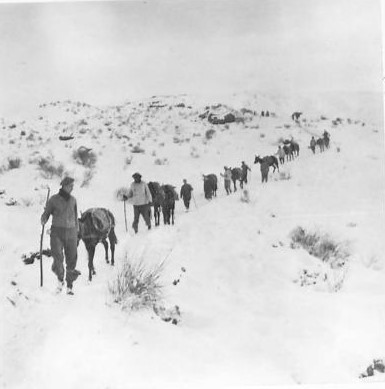
The administrative side of the battalion worked as it never had before. When the weather was bad, either mud or snow, it took six hours to get from the forward areas to B Echelon, about fifteen miles away at Firenzuola. Supplies were conveyed on mules, and some idea of the mud can be gauged from the fact that along one mule track could be seen the heads of many dead mules standing up in the mud where they had stuck, sunk, and been shot.
In mid-November the battalion moved north of the Sillaro River to hold sectors on the southern slopes of Monte Grande, part of the very last ridge overlooking the Po Plains. Their adversaries were the 1st Parachute Division, one of the best left in the German Army, and whom they had met before in Sicily and at Cassino.
No major incident disturbed the normal routine of shells, mortar bombs, and patrols. The battle patrol of F Company men, under Lieutenant Montgomerie, carried out a – highly successful raid in daylight on a farm occupied by a platoon of the enemy. Four Germans were killed and the rest put to flight. Reconnaissance and planning for this raid took almost a week, but it was accomplished without a casualty, and Lieutenant Montgomerie received a Bar to his MC. On another occasion Lance-Corporal Faizey distinguished himself by capturing a patrol of four Germans who tried to pass themselves off as Canadians.
The team of officers which led the 2nd Battalion through that undistinguished but hard winter were Lieut-Colonel Bredin DSO MC, Major G Fitzgerald (E Company), Major Ted Griffith (G Company), assisted by Lieutenant Gartside. Major Craig and later Major JD Lofting led H Company, the mortar platoon was under Lieutenant Ken Daly, and the medium machine-guns were under the command of Lieutenant Neale. Major GG Hall commanded the Support Company, Captain RG Cockburn Headquarters Company, Captain GE Cole was Adjutant, and Lieutenant D Aitkenhead was still the very able and energetic Quartermaster. The transport section was led by Captain Ivan Yates; Lieutenant John Barker was in charge of the pioneers, and Lieutenant Ken Lovatt was Signals Officer. Lieutenant F Lyness, the Intelligence Officer, took up a post as an instructor at the Central Mediterranean Training Centre, Benevento.
Lieut-Colonel Bredin left the battalion temporarily to act as GSO 1 at 78th Divisional Headquarters, and Lieut-Colonel JD Stewart, formerly Second-in-Command of the Royal Irish Fusiliers, took over. Lieut-Colonel Bredin returned six weeks later, and Lieut-Colonel Stewart became Second-in-Command. Major Mervyn Davies came back from hospital to command E Company, with Captain F Cave as his Second-in-Command.
At the end of January, the 2nd Battalion had a very acceptable rest in the Florence neighbourhood, after which they moved with the rest of the 78th Division over the mountains to the plains of the River Po at Forli. F Company was re-formed under Major Fitzgerald and Captain Desmond Fay before the battalion went into the line once more at the beginning of March.
As spring came, the battalion found that on the plains it had come into a new kind of warfare, a war of tunnelling, sniping, and periscopes, but with the luxuries of dry roads, houses, and good weather. The surprisingly dry spring was a good omen for the decisive battles to come, and the good fortune was deserved by the veterans of the Eighth Army who had had two grim winters in Italy.