38th (Irish) Infantry Brigade was created in early 1942 at the instigation of UK Prime Minister Winston Churchill.
In late 1941, Churchill had demanded the creation of an Army Brigade with its constituent units having direct connections with Ireland.
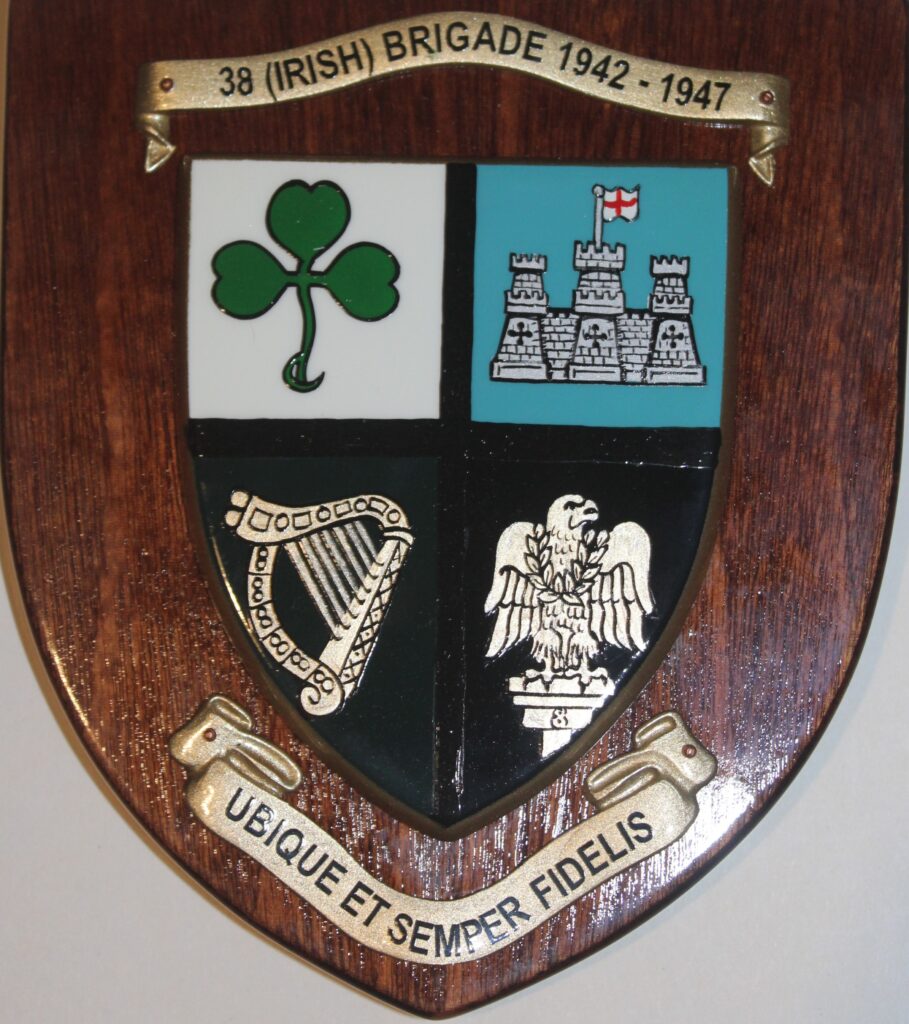
When it was formed, its initial infantry battalions were 1st Bn. Royal Irish Fusiliers, 6th Bn. Royal Inniskilling Fusiliers and 2nd Bn. London Irish Rifles and they came together for the first time in Norfolk in January 1942.
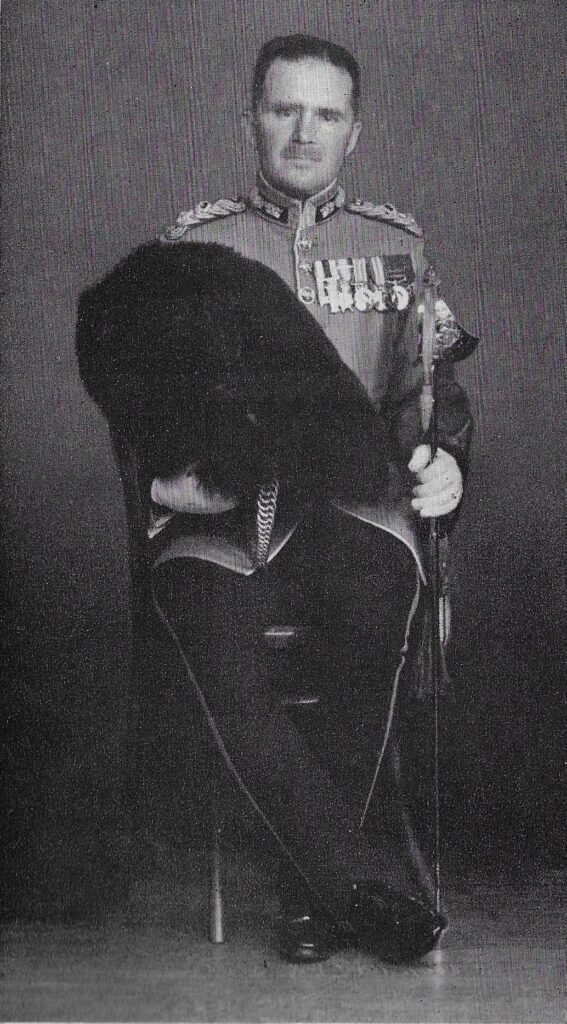
Soon afterwards, the Irish Brigade was allocated to the 6th Armoured Division, which was preparing to participate in the Allied invasion of French North Africa when American and British troops were to fight together for the first time since the US joined the war against Germany and its allies.
After initial training at Didlington in Norfolk, the Irish Brigade was moved to Auchinleck, 40 miles south of Glasgow, for intensive preparation for their part in the North African landings: Operation Torch.
On 12th November 1942, most of the brigade, now part of the mainly British 1st Army, en-shipped at Greenock on the River Clyde west of Glasgow to join the operation which had begun four days earlier with Allied landings in Morocco and Algeria. Both countries were then under the control of France’s Vichy government which had been created after France signed an armistice with Germany on 22nd June 1940.
The Irish Brigade started to disembark on 22 November 1942 in Algiers and was immediately subjected to its first experience of Luftwaffe bomb attacks. A week later, the brigade was moved by train to Bougie from where it was transported by truck over the border into Tunisia, and then put into the front line about 100 miles south-west of Tunis. The Faughs arrived in North Africa in mid December.
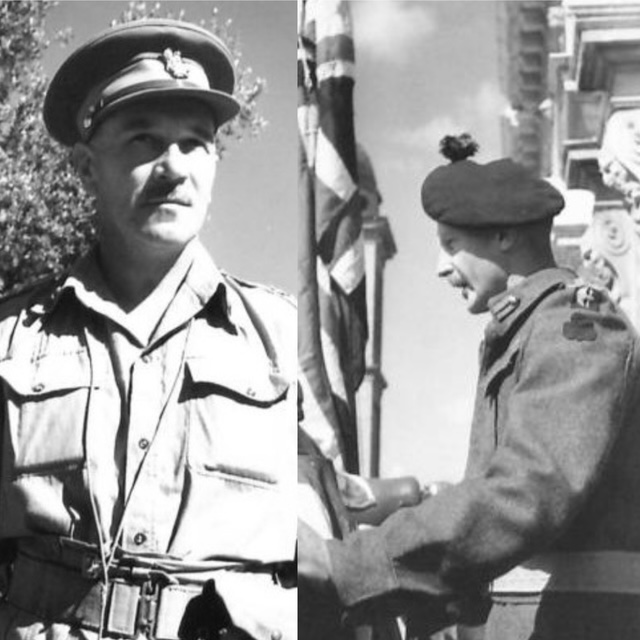
The first serious fighting involving the Irish Brigade took place north of Bou Arada in January, with the first battalion-scale attack taking place on 13 January 1943 against German positions on Two Tree Hill, a high point which dominated the flat land between the Goubellat Plain in the north and the Bou Arada Plain in the south. The attack was carried out by the Skins and proved unsuccessful and the battalion lost 28 dead on the day and sustained almost 100 casualties in total.
All three battalions were subsequently involved in battles north of Bou Arada in January and February 1943 and, after being transferred to the 78th Infantry Division in March, then played a critical role in the final battles in the mountains west of Tunis in April. The city fell to the Allies on 7 May and the Irish Brigade was given the distinction of being the first marching troops into the Tunisian capital on the 8th. Caught between Allied armies advancing from the west and General Bernard Montgomery’s 8th Army advancing from the south, hundreds of thousands of Germany and Italian soldiers were taken prisoner. The Irish Brigade joined the subsequent victory parade through Tunis on 20 May 1943.
The UK and the US had by then decided that Allied forces should be used to capture Sicily which dominated the sea lanes between the western and eastern parts of the Mediterranean Sea. The invasion of Sicily started on the night of 8 July 1943 and the Irish Brigade, now part of Montgomery’s 8th Army but initially held in reserve, set out for Sicily from Sousse and started landing south of Syracuse on 26 July.
Italy’s defeats at the hands of the British Army in Abyssinia, Egypt, Libya and Tunisia and the loss of hundreds of thousands of soldiers in fighting in the Mediterranean and the Soviet Union had undermined support for Benito Mussolini. The invasion of Sicily was the last straw. The Allies bombed Rome on 19 July and, five days later, the Fascist Grand Council passed, by a majority, a vote of no confidence in Mussolini, who was then arrested the next day. Marshall Pietro Badoglio was appointed head of a military government and, before the Allied landings on the Italian mainland in September 1943, announced Italy would be joining the Allies as a “co-belligerent”.
The Allied plans in Sicily called for the 8th Army to break through German lines that extended from the east to the north coast of the island. The Irish Brigade was transported towards Catenanuova in the centre of Sicily, and from there, the brigade advanced by foot. It was given the task of capturing Centuripe, a small town high on a ridge in the Sicilian mountains, west of Mount Etna, and which was at the centre of the Axis defensive line. The attack by the Irish Brigade on Centuripe began on the afternoon of 2 August and the hill-top town was taken before dawn the following day. The brigade pursued the enemy, crossed the shallow River Salso and then the River Simeto. On 12 August, and after five days rest, the brigade attacked a further defensive line that extended north-west from the foothills of Mount Etna. With both American forces and the 8th Army converging on Messina, the Germans were forced to withdrew and evacuated Sicily entirely on 17 August.
Encouraged by the comparatively easy capture of Sicily, the Allies decided to invade the Italian mainland. The Italian government finally accepted the Allies’ terms and surrendered on 3 September 1943 but, in response, the German Army immediately took control of the country, disarming and imprisoning hundreds of thousands of Italian soldiers, and accelerated work on a series of formidable defensive lines to be built right across Italy.
The Allied invasion of the Italian mainland began with the 8th Army landing on the toe of Italy. The 5th Army, under US General Mark Clark, landed at Salerno south of Naples on 9 September. German resistance was determined and the Allied beachhead was almost overwhelmed but, with the aid of naval gunfire, was able to stabilise the front and the 5th Army was able to advance and capture Naples on 1 October.
Meanwhile, the Irish Brigade was transported by ship from Messina to Taranto where it disembarked on 24th September. From there, it was moved by train to Barletta on Italy’s Adriatic coast and, on 5 October, the brigade was moved by landing craft further up the coast to Termoli where an 8th Army attack had begun two days earlier. All three battalions were involved in fighting around Termoli and eventually repulsed determined German counterattacks. This was followed up by an attack on the town of Petacciato before the River Trigno was crossed. On the night of 27 October, the brigade tried to break the German line around San Salvo, north of the Trigno. Although initially unsuccessful, the town was taken by the whole of the 78th Division in a subsequent attack in early November.
The next obstacle was the Winter Line, a formidable band of fortifications that stretched from the Adriatic coast and across the Apennines to the Tyrrhenian Sea. The weather had changed and it rained continually and the Sangro river had burst its banks. The Irish Brigade would participate in the successful attack on German positions on a ridge about 1,000 metres north of the river which was completed in early December. The 8th Army’s assault against German positions north of the Sangro continued but the brigade was withdrawn from the line and transferred to occupy winter positions close to the German lines in the central Apennine mountains near to Castel di Sangro. The Irish Brigade held these positions until late January.
Brigadier T.P.D. (Pat) Scott, a Faughs’ officer, replaced Nelson Russell as Brigade Commander in February 1944 and, after a short period of rest and recuperation out of the front line, the brigade was readied to capitalise on any breakthrough that might result from the third Allied attempt to break the Gustav Line around Monte Cassino. The allies were repulsed and the brigade was then deployed for a few days on the front line on the south side of the River Gari opposite the village of San Angelo. From there, it was transferred to positions on the slopes of Monte Castellone, which overlooked the abbey of Monte Cassino and, in turn, was replaced there on 25 April by the Polish Corps, with the brigade being withdrawn for rest and training in preparation for the 4th Battle of Cassino.
The final and largest assault on the Gustav line began on 11 May 1944. The 78th Division was given the task of continuing the Allied breakthrough into the Liri Valley, and the Irish Brigade crossed the Gari on 14 May in preparation for their part in the battle. The Skins took the lead on the 15th and, at 9am on the following day, the London Irish Rifles carried forward the assault by capturing the fortified hamlet of Sinagoga with the Faughs joining the battle on the 17th. Monte Cassino was eventually captured by the Polish Corps on 18 May. The battle for Cassino was over but the campaign continued and the 78th Division chased the German rearguard north towards Rome and then further north of the city until they reached a fresh German defensive position, the Albert Line, which ran east and west of Lake Trasimene in Umbria.
All three battalions were involved in the attack on the line on a ridge around the town of Sanfatucchio which began on 21 June. Most of the brigade’s objectives were taken by 25 June and it was pulled out of the line for rest in Egypt, where it stayed for six weeks. In early August 1944, the 6th Battalion of the Skins was disbanded and the brigade was brought up to strength by replacing it with the 2nd Battalion of the Skins, who transferred from the 5th Infantry Division.
The Irish Brigade returned to Italy in September 1944 and participated in the rolling Allied attack during the autumn against the Gothic Line in the Apennine Mountains north of Florence. At this stage, the brigade temporarily joined the 5th Army and participated in battles around Monte Spaduro which began on 19 October. Due to the onset of winter conditions, the Allies failed to break through the Gothic Line and suspended the assaults as the weather deteriorated.
Having returned to 8th Army at the start of February 1945, the brigade was transferred to the eastern end of the Gothic line and prepared for the final assault on the Germany army in Italy, which began with an attack across Lake Commacchio on the night of 5 April 1945. The Irish Brigade advanced through the Argenta Gap and reached the River Po on 25 April. During this comprehensive defeat, German resistance disintegrated entirely and the brigade advanced quickly through northern Italy and later crossed into Austria. The German Army in Italy surrendered on 2nd May and the Second World War in Europe finally ended on 8 May 1945.
The Irish Brigade then took up occupation duties in Carinthia in southern Austria and was eventually formally dissolved in April 1947.