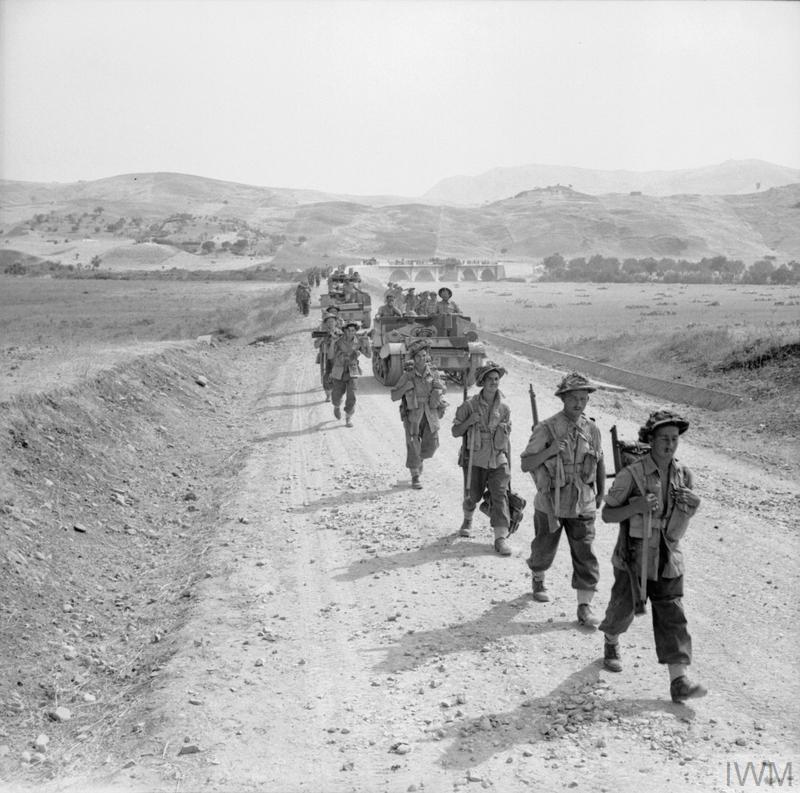
General Montgomery inspected the battalion one evening just before Lieut-Colonel Scott left. The 78th Division had been transferred to the Eighth Army, and the reason for the Army Commander’s visit was that he might see the new men under his command.
He found the battalion fit and ready for its next task.
PERSONAL MESSAGE FROM THE ARMY COMMANDER TO BE READ OUT TO ALL TROOPS.
July 1943.
“The time has now come to carry the war into Italy, and into the Continent of Europe. The Italian Overseas Empire has been exterminated; we will now deal with the home country.
To the Eighth Army has been given the great honour of representing the British Empire in the Allied Force which is now to carry out this task. On our left will be our American Allies. Together we will set about the Italians in their own country in no uncertain way; they came into this war to suit themselves and they must now take the consequences; they asked for it, and they will now get it.
On behalf of us all I want to give a very hearty welcome to the Canadian troops that are now joining the Eighth Army. I know well the fighting men of Canada; they are magnificent soldiers, and the long and careful training they have received in England will now be put to very good use – to the great benefit of the Eighth Army.
The task in front of us is not easy. But it is not so difficult as many we have had in the past, and have overcome successfully. In all our operations we have always had the close and intimate support of the Royal Navy and the RAF, and because of that support we have always succeeded. In this operation the combined effort of the three fighting services is being applied in tremendous strength, and nothing will be able to stand against it. The three of us together – Navy, Army, and Air Force – will see the thing through. I want all of you, my soldiers, to know that I have complete confidence in the successful outcome of this operation.
Therefore, with faith in God and with enthusiasm for our cause and for the day of battle, let us all enter this contest with stout hearts and determination to conquer.
The eyes of our families, and in fact of the whole Empire, will be on us once the battle starts; we will see that they get good news and plenty of it.
To each one of you, whatever may be your rank or employment, I would say:
GOOD LUCK AND GOOD HUNTING IN THE HOME COUNTRY OF ITALY!
BL MONTGOMERY, General
The invasion of Sicily was a well-planned and boldly executed operation in which the sea, air, and land forces each played a vital and successful part. It was an operation which the Italians, at any rate, did not think could possibly succeed. The first landings by sea and air were made where they were least expected, and so surprised were the enemy that on the first day the landings were practically unopposed.
Sicily, an island about one hundred and sixty miles wide and about ninety miles from north to south, is about half the size of Ireland. It is high, mountainous country intersected by deep gorges with rivers running swiftly between precipitous cliffs. Along parts of the coast are narrow plainlands, but except the Catania Plain on the eastern side there is no really flat country in the island. Mount Etna, eleven thousand feet, is the highest of a rugged group of mountains.
The Sicilians, a hardy mountain race, appeared intensely to dislike the Italians, and Mussolini in particular. Throughout the island small villages of ancient stone houses, perched amid the mountain peaks, formed a series of fortresses. They were designed to be impregnable in the Middle Ages with the primitive weapons of those days. In fact, as the Sicilian campaign progressed, they proved to be difficult obstacles when defended with modern weapons.
The British Eighth Army, fresh from their triumph in North Africa, landed on the beaches of the east coast of Sicily, south of Syracuse, the ancient city founded by the Corinthians several centuries before Christ. The port, scene of stirring battles between the Athenians and the Syracusans, was captured and was quickly made ready to receive the reinforcements which followed up behind the assault troops. The historic old city had escaped devastation.
The next objective was the Catania Plain and its spacious airfields, thence east and west of Mount Etna, to converge again in the neighbourhood of Taormina. The American Seventh Army landed on the south coast near Gela and proceeded towards Palermo and Marsala on the west side of the island.
Montgomery’s plans went with a swing. The Eighth Army pushed northwards up the coast until stiff resistance was met outside Catania. The Americans made impressive progress against less stubborn opposition. Palermo and Marsala fell, and the western half of Sicily was almost cleared up.
There were about three German divisions in the island, and they were reinforced by several paratroop brigades fighting as infantry. They were all picked troops and they put up a desperate, stubborn, but hopeless fight with skill and determination. There were four hundred thousand Italians there, too, but they did not seem to function much as soldiers. They surrendered in thousands.
Forsaken by the Italians, the Germans found that their best friend was the country, which could not have been more suitable for a defensive battle. The first impetus of the invasion over, the enemy recovered from his surprise and regrouped his forces to meet the main Allied thrusts. The Allied troops had been fighting in difficult country in an oppressive and tiring heat, and it was necessary that the original invaders should be rested and that new men should go forward.
A new co-ordinated plan was prepared to overcome the reorganised resistance of the Germans. There was, of course, no breaking of contact and no relaxation in the pressure by the British and American forces on land and in the air. Fighting continued in each sector, but advances were made with a view to preparing for the final push.
The 50th Division had been on the first assault, and 168 Brigade, with the 1st Battalion London Irish, began to reach the island three days after the initial invasion.
The 78th Division, in which was the 2nd Battalion London Irish, landed on July 26-27. The 78th Division had now left the First Army and was making its first appearance with the Eighth.
This was the first time that the two battalions of the Regiment had been in the same theatre of war since leaving England.
The plans for the final push were roughly that the Eighth Army should proceed along the eastern side of the island, capture Catania and Regalbuto, and encircle Mount Etna by the inland road through Aderno, Bronte, and Randazzo. The American Seventh Army should cover westwards of Regalbuto to the north coast and advance on Messina by the two northern routes.
The 78th Division was on the left flank of the Eighth Army and became a connecting-link with the Americans. The 50th Division was on the right flank, fighting its way up along the east coast.
The time had now arrived for what became known as Montgomery’s left hook. The Americans were pressing in the west, and the time had come for a strong blow in the centre. To the troops came the following message from their leader:
EIGHTH ARMY – PERSONAL MESSAGE FROM THE ARMY COMMANDER TO BE READ OUT TO ALL TROOPS.
1. The Allied Armies landed in Sicily, on Italian soil, on 10th July, magnificently supported by the Royal Navy and the Allied Air Forces, and are to-day in possession of the whole island except for the north-east corner where the enemy is now hemmed in.
2. I want to tell all of you, soldiers of the Eighth Army, that this has been a very fine performance. On your behalf, I have expressed to the Commander of the Seventh American Army on our left the congratulations of the Eighth Army for the way the American troops have captured and cleaned up more than half the island in record time. We are proud to fight beside our American Allies.
3. The beginning has been very good, thanks to your splendid fighting qualities and to the hard work and devotion to duty of all those who work in the ports, on the roads, and in the rear areas. We must not forget to give thanks to “THE LORD MIGHTY IN BATTLE” for giving us such a good beginning towards the attainment of our object.
4. And now let us get on with the job. Together with our American Allies we have knocked Mussolini off his perch. We will now drive the Germans out of Sicily.
5. Into battle with stout hearts. Good luck to you all.
BL MONTGOMERY, General,
Eighth Army.
SICILY JULY 1943.
The key position in the German defence line across Sicily was Centuripe, a village perched on the top of a formidable line of steep hills. Its precipitous sides gave it an almost impregnable position. The lesser hills round it were well defended by the enemy and it was necessary for them to be mastered before Centuripe could be tackled.
The 78th Division got together for a drive towards Catenanuova and to capture Centuripe. The country between the two villages was wild and extremely rough. Great rocky crags, similar to those among which the 2nd Battalion had fought in North Africa, covered the one mountain road between them.
The Irish Brigade had to take Centuripe, and the scheme was for a silent night advance to be made with heavy gun-fire available at call. The 6th Royal Inniskilling Fusiliers and the Royal Irish Fusiliers were given the main tasks, and the 2nd Battalion London Irish were ordered to make a dangerous flank secure.
On the evening of August 1, the battalion moved to a lying-up area in the wadis below the foothills of Centuripe. No transport was able to get forward and that meant that all ammunition, food, and other supplies had to be man-handled. That was a considerable problem and made the operation very tiring and tedious. At noon next day the London Irish went forward to a line behind the 6th Royal West Kent Regiment, who were fighting in the hills behind Centuripe, and in the August haze they could see the village resting lazily and sleepily on the summit of the long, vast hill. The job of the London Irish was to take three commanding hills, Points 704, 611, and 703, behind Centuripe. It was not known in what strength they were held by the enemy.
It was hoped that most of his attention would be to the main battle and that he would have little time to look after his ‘‘back door.”
G and F Companies crossed the start-lines after a fifteen minutes’ warm-up by the gunners, and they were soon on Points 704 and when G Company had made good their task, H Company moved on to take Point 703. They had been unlucky on the start-line and had had some casualties. Theirs was a more difficult job and they had to face machine-guns from the hill and from the sides. G Company helped in silencing the enfilade fire, and when darkness came the London Irish consolidated on the ground gained. This third hill still held out and the decision had to be made whether to wait until it had fallen, or to carry on without delay and rely on the preoccupation of the enemy with the left-flank attack. The latter course was taken; the Royal Irish Fusiliers put in their assault towards the north and rear of Centuripe, and the Skins, who throughout had been in close contact with the enemy on the frontal sector, obtained a foothold on the southern edge of the village after a heavy barrage. The Royal Irish Fusiliers pushed through the northern end. The fighting was stubborn and hard, and many good fellows were lost, but just before dawn on August 3 Centuripe fell to the Irish Brigade, and this success caused the whole German line to Catania to crack. The operation had been a tough one, in difficult country and against a dogged enemy, and chief credit for the success was due to the Skins, who bore the brunt of the fighting and fought with fine spirit and determination.
There was no respite after Centuripe had been captured. The Irish Fusiliers mastered heights beyond the village, and the London Irish, marching through Centuripe, reached rising ground overlooking the River Salso. The transport had difficulty in getting down the winding road from Centuripe because of a large crater which took the sappers twelve hours to fill in and also because the enemy, far from being finished with, scattered mortar bombs and shells in the area.
The Salso had to be crossed. There was an ugly gap about one hundred feet wide in the bridge, and no repair material could reach the riverbank until the road crater had been made good. Bulldozers were up quickly, but work could be done only at night, owing to the German fire. The Royal Engineers succeeded, however, in doing a magnificent job and the gunners were soon stepped up to help the troops.
Three patrols each a platoon strong went out from G Company to locate enemy posts and to mark out approaches for the crossing. They discovered that the Salso was only a few inches deep and, getting over safely, they penetrated as far as the River Simeto, which ran northwards from a bend in the Salso to the west. Lieutenant O’Connor’s patrol went to a blown bridge over the Simeto on the main Centuripe-Aderno road; Lieutenant I. D. White and his men went to a viaduct a little to the north, and Lieutenant Lyness’s patrol reached Carcaci, a small village to the west of the Simeto. They met no enemy between the two rivers and got back with information vital for further progress.
Patrols went out again next day, and Sergeant Donaghy and his men of F Company reported some machine-gun posts, but it was apparent that there was no strong, organised defence along the riverbanks. Actually, when the London Irish and the Royal Irish Fusiliers attacked at 1500 hours on August 4, there was no German opposition in strength at all. What little there was, came from a few snipers and machine-guns left behind to harass the advance. The London Irish quickly reached high ground on the far side of the Salso, and at night E and F Companies got to the Simeto. Supporting arms were rushed up, and at daylight it was seen that the other bank was strongly held by the Germans. Sharp exchanges of fire took place during the morning, and the mortars had a busy time keeping the heads of the enemy down on the far bank. At first light E Company occupied the village of Carcaci and pushed one platoon down to the riverside, and at the same time battalion headquarters, with H Company in reserve, moved up to the railway station. Plans were made to gain a bridgehead. The river was fast flowing, and deep in many places. Where it was not deep, smooth boulders and rocks rested on the riverbed, making a foothold precarious. The banks on both sides were steep, rising at times nearly a hundred feet. That held by the enemy was covered in dense undergrowth, affording only a few good approaches, which were well covered by snipers and Spandau posts. It was honeycombed with caves, in which more Germans were hidden.
The attack was timed for 1500 hours, but during the morning a party of Germans, about fifty strong, were seen trying to work round the left of the battalion. They were scattered by fire from E Company and the heavy mortars of the Support Group. Later a Canadian force came up on the left and completed the discomfiture of the Germans, who disappeared as fast as their legs could carry them. E Company also sent patrols to try to cross the river, but they were unable to get very far owing to the vigilance of the enemy. They succeeded, however, in pin-pointing many positions.
With the artillery booming in support the crossing was made by the London Irish and the Royal Irish Fusiliers, with the Skins held in reserve. F Company got over and made for a small hill with an isolated yellow house standing nearby. H Company tackled another hill on the left. Both features were hardly discernible on the ground and were a few hundred yards from the river. As they scaled the steep slopes from the river the foremost platoon of F Company found themselves in a bottleneck among the undergrowth and bushes, and many men fell. Lieutenant Allen, who had recently joined the battalion from the 8th Battalion Royal Ulster Rifles, was killed, while leading his platoon, by a sniper who fired at point-blank range. The German died soon afterwards.
The third platoon of F Company moved round to the right and after a sharp encounter found themselves facing the yellow house. It was a strongly built stone building, and Lieutenant K Daly, with Sergeant S Kelly and a handful of men, fought their way in. There was a sudden counterattack, and to avoid being cut off by a more powerful force the small party withdrew back to the rest of the platoon. Gradually, with the enemy rushing all available men forward, the three platoons of F Company, with very little cover in open country, had to pause. They held tight under a rain of fire until, with the help of reserves from the Skins, the building was blasted at short range and stormed.
H Company had similar experiences but lost more men from sniper and machine-gun fire. They had an even more difficult advance up the north bank of the river and were forced to proceed in single file. The leading platoon, under Lieutenant Michael Clarke, went forward clearing snipers and Spandaus, while 18 Platoon disposed of enemy groups which were harassing the company from the protection of a viaduct on the left. In a gallant attack on a well-defended German post several men, including Lieutenant Howells, the Platoon Commander, were killed but the enemy were silenced.
Throughout this hard battle G Company and the supporting weapons of the battalion gave all assistance possible from the south bank of the river. As dusk approached, two platoons of G Company moved across the river with reserve ammunition, mortars, and machine-guns for the immediate support of the two other companies. By darkness the bridgehead was secure, and the Germans withdrew during the night.
In the morning a fighting patrol from the London Irish located the enemy half-way up the hills on top of which was the next objective, the much-bombed town of Aderno.
That, however, was not an Irish Brigade task, for the two other Brigades of the 78th Division went through, leaving the Irish Brigade to bathe in the cool waters of the Simeto, upon which they felt quite justifiably they had some claim.
From the afternoon of August 1 to nightfall on August 5 the Irish Brigade had advanced twenty-five miles and had had three exceptionally tough fights – Centuripe, Salso, and the Simeto. But everything had depended upon the sappers. The way they got their material forward and overcame all obstacles was magnificent. The brigade and the London Irish in particular were very well served.
The battalion spent five days resting by the Simeto, by which time the rest of the division had captured Aderno and Bronte, and were holding the hills on the far side of the latter town. The crossing of the Salso and Simeto Rivers and the fall of Aderno had cut all the German lateral communications west and south of Mount Etna, and caused the fall of Paterno, Santa Maria, and Biancavilla.
Refreshed by their stay by the river, the Irish Brigade took up the running. In front of the hills behind Bronte was a long stretch of low ground, very thickly wooded and full of terraces and narrow stone tracks. In the distance, jutting out against the skyline, were three prominent features. The first was Mount Macherone, the second Capella, and the third a long ridge called the Sperina. The first two hid the small village of Maletto. The Irish Brigade were ordered to take these hills and Maletto, with the assistance of the 8th Argylls. The plan was for the Scots to take Mount Macherone and to make good the London Irish start-line, the Irish Fusiliers to take the Capella and Maletto, and the London Irish on the right flank to take the main feature, Sperina, and another peak just behind called Monte Maletto. On August 11 the battalions moved to a forward area south of Bronte, and there they said good-bye to their motor transport, which had worked valiantly since the landing and had negotiated with skill and coolness hazardous mountain roads and tracks, with their giddy bends, stiff climbs, and perilous descents.
The London Irish changed over to pack transport, because if the country already traversed was unsuitable to a mechanised army, that which lay immediately ahead was even more so.
The Battle of Maletto was to be a night advance followed by an attack just before dawn, preceded by a heavy artillery barrage. Late on the 11th, light bombers gave Sperina and Capella a sound and accurate bombing for three-quarters of an hour. At 2100 hours the London Irish left on the approach march to the start-line. That night advance through absolutely impossible country proved to be a most difficult operation. Major Kevin O’Connor, who was acting Commanding Officer, owing to Lieut-Colonel Rogers being on the sick-list, realised on his reconnaissance that the march would not be easy, but it was far worse than he or anyone else had conceived. There were thick, high walls, rocky tracks in close-wooded country with innumerable bushes, thick undergrowth, and steep terraces every few yards. All these were awkward obstacles, making advance by compass very difficult indeed. In addition, man-handling ammunition, supporting-arms, and the rear link No. 19 Wireless sets was by no means easy. The advance consequently took much longer than had been estimated. In that treacherous ground the battalion inevitably became split up. By 0400 hours two platoons of F Company and two platoons of G Company were in the forming-up area, under Major JD Lofting. The acting Commanding Officer was forward with the remaining platoons of those companies, and he ordered the attack to proceed.
Zero hour had been at 0230 hours, when the artillery had laid their barrage. Gunfire had in fact ceased an hour before the London Irish were ready for their attack and as dawn was breaking the utmost speed was necessary. The platoons advanced towards their objectives, meeting heavy enfilade fire from the right. It was here that Sergeant McCrory, a first-class man and a very good platoon commander, was killed.
Due to the dash and courage shown by the leading platoons, ably led by Lieutenant HND Seymour and Lieutenant JD White, the attack went well. Before long a total of thirty prisoners had been taken, hut the position was not an easy one. The Germans were still holding wooded ground to the right rear and keeping up continuous fire on the London Irish. At 1030 hours F Company were ready to attack, and they went across the bullet-swept ground to take their objective on the right of Sperina. Here something went wrong, because it was intended that they should sweep round to the right and on the way mop up the enemy who were making life unpleasant for the forward companies. They did not carry out this plan but went straight for the hill, which they took despite heavy mortar and machine-gun fire. Why the plan partly miscarried will never be known, because Major J Fitzgerald MC , F Company Commander, was killed while crossing the open country below the hill. A delightful personality and a fearless officer, his death was a great loss to the battalion.
The Royal Irish Fusiliers in the meantime had captured Capella and Monte Maletto and cleared the village. The Skins, too, had come out from reserve and made a long, slow journey over lava country to tackle enemy forces causing trouble on the right.
The enemy’s general position became untenable after this battle. By eight o’clock in the evening firing had died down and as darkness came the enemy evacuated their lines, leaving patches of “S4” mines to hamper our progress. That night the Irish Fusiliers were relieved by a Scottish battalion, and they went forward with the main Maletto-Randazzo road as their axis. The Skins continued their protective move on the right, and the London Irish, leaving one company to hold Sperina, assembled to support quickly either the Faughs or the Skins.
The Irish Fusiliers thrust forward with the help of the gunners, and by 0830 hours they had not only hit the enemy hard but had chased them in the darkness five to six miles. A detour had to be made to avoid American shelling, and then at 0930 hours on August 13 they made contact with the American 1st Division. Though German resistance was limited to a few ambushes, the Faughs’ line of advance was thick with Teller and “S” mines, which made the going hazardous in the darkness and took frequent toll of a battalion determined to complete the task given to it.
The fall of Maletto and the rapid approach to Randazzo started the Germans on their last hurried rush to the sea.
This phase of the fighting left the Irish Brigade half-way along the long slopes of Mount Etna, between Randazzo and Maletto. They were several thousand feet above the sea, and the nights were cool and pleasant. The main characteristic of the country was lava dust, a fine, reddish-brown powder which seemed to penetrate everywhere and everything. For days the troops had marched, fought, and rested in this dust, which covered them from head to foot, and they yearned for the blue waters of the Mediterranean where, from pleasant, shaded sands, they could clean themselves.
The 2nd Battalion rested near Patti, a very good spot less than fifty yards from the sea, with shady olive- and fruit-trees. In the distance the peaceful Lipase Islands turned thoughts to things other than war, to pre-war and perhaps post-war holidays. Gaily coloured fishing boats sailed to and for, and on the horizon, Stromboli poured out its clouds of smoke.
Six weeks were spent in these pleasant surroundings. Training was resumed, and new drafts arrived to bring the battalion once more up to strength. It was necessary that everyone should, once again, be fighting fit, because another and grimmer task was ahead—the invasion of Southern Italy and the forcing of the back door into Hitler’s European fortress.