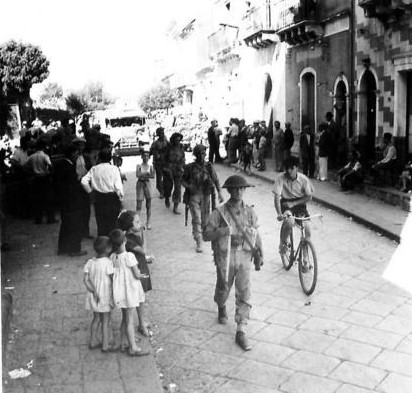
The invasion of Sicily was a well-planned and boldly executed operation in which the sea, air, and land forces each played a vital and successful part. It was an operation which the Italians, at any rate, did not think could possibly succeed. The first landings by sea and air were made where they were least expected, and so surprised were the enemy that on the first day the landings were practically unopposed.
Sicily, an island about one hundred and sixty miles wide and about ninety miles from north to south, is about half the size of Ireland. It is high, mountainous country intersected by deep gorges with rivers running swiftly between precipitous cliffs. Along parts of the coast are narrow plainlands, but except the Catania Plain on the eastern side there is no really flat country in the island. Mount Etna, eleven thousand feet, is the highest of a rugged group of mountains.
The Sicilians, a hardy mountain race, appeared intensely to dislike the Italians, and Mussolini in particular. Throughout the island small villages of ancient stone houses, perched amid the mountain peaks, formed a series of fortresses. They were designed to be impregnable in the Middle Ages with the primitive weapons of those days. In fact, as the Sicilian campaign progressed, they proved to be difficult obstacles when defended with modern weapons.
The British Eighth Army, fresh from their triumph in North Africa, landed on the beaches of the east coast of Sicily, south of Syracuse, the ancient city founded by the Corinthians several centuries before Christ. The port, scene of stirring battles between the Athenians and the Syracusans, was captured and was quickly made ready to receive the reinforcements which followed up behind the assault troops. The historic old city had escaped devastation.
The next objective was the Catania Plain and its spacious airfields, thence east and west of Mount Etna, to converge again in the neighbourhood of Taormina. The American Seventh Army landed on the south coast near Gela and proceeded towards Palermo and Marsala on the west side of the island.
Montgomery’s plans went with a swing. The Eighth Army pushed northwards up the coast until stiff resistance was met outside Catania. The Americans made impressive progress against less stubborn opposition. Palermo and Marsala fell, and the western half of Sicily was almost cleared up.
There were about three German divisions in the island, and they were reinforced by several paratroop brigades fighting as infantry. They were all picked troops and they put up a desperate, stubborn, but hopeless fight with skill and determination. There were four hundred thousand Italians there, too, but they did not seem to function much as soldiers. They surrendered in thousands.
Forsaken by the Italians, the Germans found that their best friend was the country, which could not have been more suitable for a defensive battle. The first impetus of the invasion over, the enemy recovered from his surprise and regrouped his forces to meet the main Allied thrusts. The Allied troops had been fighting in difficult country in an oppressive and tiring heat, and it was necessary that the original invaders should be rested and that new men should go forward.
A new co-ordinated plan was prepared to overcome the reorganised resistance of the Germans. There was, of course, no breaking of contact and no relaxation in the pressure by the British and American forces on land and in the air. Fighting continued in each sector, but advances were made with a view to preparing for the final push.
The 50th Division had been on the first assault, and 168 Brigade, with the 1st Battalion London Irish, began to reach the island three days after the initial invasion.
The 78th Division, in which was the 2nd Battalion London Irish, landed on July 26-27. The 78th Division had now left the First Army and was making its first appearance with the Eighth.
This was the first time that the two battalions of the Regiment had been in the same theatre of war since leaving England.
The plans for the final push were roughly that the Eighth Army should proceed along the eastern side of the island, capture Catania and Regalbuto, and encircle Mount Etna by the inland road through Aderno, Bronte, and Randazzo. The American Seventh Army should cover westwards of Regalbuto to the north coast and advance on Messina by the two northern routes.
The 78th Division was on the left flank of the Eighth Army and became a connecting-link with the Americans. The 50th Division was on the right flank, fighting its way up along the east coast.
The 1st Battalion of the London Irish Rifles had sailed from Suez in the SS Karoa at the end of June and left there for Port Said on July 1. Two days later it joined a convoy of twelve ships sailing to Alexandria, which was reached on July 4. The battalion went into camp for a few days in order to prevent congestion in the city in the event of an air attack. Re-embarking on July 8 the battalion left in convoy for Syracuse the next day.
Lieut-Colonel Good explained to all ranks that as the battalion was part of the reserve brigade, its role was still uncertain, because the invasion of Sicily had already started. It was a little comforting to know that our role was not to be that of assault troops on the Sicilian beaches! Four days were spent at sea and the voyage was uneventful. Everyone expected at least an attempted raid by aircraft or submarine, but there was not the slightest hint of one, so complete was the Allied command of sea and air. The SS Karoa was the first British merchant vessel to enter Syracuse harbour, and she did so with the willing assistance of an old Sicilian pilot who had been put aboard by a Royal Naval launch. He was a picturesque character in shirtsleeves and an old straw hat, and he amused everyone by shaking hands with all he met. He, at any rate, was glad to see us in his beloved Sicily.
The battalion docked without mishap on July 13 and marched to an assembly area five miles from the port and past ruins of the fortifications which had for many months held back the Romans in their siege of Syracuse.
The day was very hot, and everyone was heavily laden with rations and extra ammunition. Mortars, additional wireless sets, and the usual signal equipment were also carried. For the first time could be heard the distant sound of guns. The night was spent in almond and lemon groves. Holes were dug more for comfort than protection, and the men were kept awake most of the night by the flak that screamed in the air above Syracuse as raid after raid was made on the port and the ships still left in the harbour. The battalion was soon joined by the transport, whose drivers had had by no means such an uneventful voyage as the rest. They got more than a thrill when a ship two hundred yards away was bombed and sunk off Avola. It was particularly unpleasant because she carried a cargo of petrol. During this incident the London Irish sustained their first battle casualty, Rifleman Smith, a transport driver, being wounded while firing a Bren at the enemy dive-bombers from the bridge of the ship.
At eight o’clock the next morning the battalion set off on foot for Mellili. The march, a long one, was very strenuous because of the great heat. The second night also was spent in the coolness of the groves, and it was here that the battalion took its first battlefield prisoners. Captain C Byrne, the Medical Officer, and a rifleman bodyguard went to look for wells. They came to a cave full of Italians and, looking in, Captain Byrne saw three men in uniform, two soldiers and a sailor. They came out without any fuss and surrendered. Captain Byrne brought them back in triumph without a shot having been fired and without the Medical Officer breaking the Geneva Convention.
There was a further move next day to Carlentini, and the battalion sheltered in an orange-grove with plentiful supplies of water.
The battalion’s first task was a long-distance patrol or “mopping-up” sweep on the Carlentini-Agnone road, during which A Company captured fourteen men of whom three were German parachutists. There were no casualties, and the battalion was able to proceed in three-tonners to an area overlooking the Catania Plain.
An attack on a brigade scale through the bridgehead which had already been forced over the Gornalunga River near the Primosole Bridge had been planned. Its direction was northwards towards Catania to the line of a ditch known as the Fosso Bottaceto. That afternoon some of the battalion, including the Mortar Platoon under the command of Captain D Gibson had their first taste of shellfire when just south of the bridge. A hasty dive for cover was followed by a quick dash over the bridge, and the mortar carriers gathered in a sunken road on the north side. It was aptly named Dead Man’s Gulch on account of the large number of dead German paratroopers, and some of our own fellows, too, who lay along it.
The brigade attack was by night on July 17, with the London Irish on the left of the thrust, the London Scottish on the right, and with the 10th Royal Berkshire Regiment in reserve. Support was to be given by the whole of the divisional artillery plus a field regiment, a medium regiment, and two regiments of self-propelled Priest guns. In addition, the Cheshire machine-gunners were to fire in support, and the light “ack-ack” to fire directional tracer on the flanks of the attack. The objective given was the Fosso Bottaceto, and thereafter it was expected that either the reserve battalion or one from another brigade would pass through.
The battalion’s plan of attack put A Company on the right, C Company in the centre, D Company on the left, and B Company in reserve; a mortar detachment in a carrier in support of each forward company and three carriers in reserve.
The assembly area was close vineyard, giving only low cover from view. It had seen considerable fighting earlier and was strewn with dead and quantities of equipment and smashed vehicles. The movement of any wheeled vehicle was extremely difficult, and all trucks were virtually confined to one narrow track in and out. Prior to the attack difficulty was experienced in getting ammunition and tools to the companies, but this task eventually was accomplished.
About thirty minutes before zero-hour information came that as it was believed that the enemy had gone – this was based on the report of an armoured reconnaissance by the Royal Tank Regiment and carriers of the London Scottish and the Royal Berkshires—the attack would now be silent, and that the preliminary artillery programme would be laid on only if called for. In any case the full barrage would come down on the German positions fifteen minutes before the infantry were timed to arrive on them.
There was hardly time to get this information to the companies who were out at the start-line.
At 2200 hours, zero hour, it became apparent that the new orders for a silent attack had not reached all concerned, for the light “ack-ack” and the machine-gunners began to fire on their tasks. The enemy did not reply.
The London Irish had moved up in daylight through vineyards and remained under cover. The start-line was one thousand five hundred yards beyond, and to reach that they clambered through German wire a foot high. When the order came to advance, they moved forward steadily with bayonets fixed. The ground was flat, hard, and apart from a few shallow ditches was devoid of cover. The first bound was a long narrow wall or bank of earth and stones protected by barbed wire. The leading companies had covered about two thousand yards and were four hundred yards from this wall when the supporting barrage opened. When it lifted, they went in to the attack. The wire was cut and they reached the bank and clambered over. The enemy had not manned it, hut as the London Irish passed over, they saw another bank, much higher, thirty yards ahead. As they approached it the Germans opened fire. The Irish got to the hank, hurled themselves up and over it, and slithered down the other side. Here they found themselves in a wide gully with yet a higher bank in front. That was their main objective, the Fosso Bottaceto. As they made towards it the enemy opened up with machine-guns, mortars, and automatics. They were so close that oil flares were thrown by the enemy and landed among the leading troops.
Along the gully from left and right German machine-guns fired deadly bursts about knee-high. Mortar bombs burst and shells came from two light-calibre guns hidden away on the flanks. Suddenly a great mass of flame went up. An oil-storage tank just behind the German lines was hit and the whole area was illuminated as by day.
The London Irishmen were caught in the glare, and some were killed at short range. The crossfire spattered against the sides of the carriers and the mortars were lifted out and mounted behind them, the only cover available. During a vital half-hour two carriers received direct hits, one of which wounded all three-mortar crew. The others mounted their mortar in a ditch and fired on.
Despite the fierce and perhaps unexpected German resistance, the men of A Company on the right, led by Major Cantopher and Captain MD Ryan, clambered up and down the banks and reached the main ditch, the Fosso Bottaceto. In the centre, C Company reached their objective, and inspired by the example of their Commander, Major Brooks, engaged the enemy hand-to-hand among the pill-boxes and earthworks. D Company on the left, under Captain Sir James Henry and Captain John Strick, pushed on doggedly but were pinned down by the fierce reaction of a wide-awake enemy. Each company had lost valued officers. Lieutenant Power was killed leading his platoon, Lieutenant Orr and Lieutenant Coghlin fell as, with great gallantry, they had pressed forward under a hail of fire.
Most of the officers and the CSM of A Company became casualties and Sergeant John Madigan, despite a wound in the arm, tackled a pillbox with one of his corporals. Indifferent to personal danger, he found his Company Commander lying wounded and he took over from him. Under his direction the company were organised once again and the fight went on. As Lieutenant AE Crampton took his men forward a bullet passed through the rim of his steel helmet and grazed his scalp. The officer was momentarily stunned, but he recovered and went on.
With their forward troops holding precariously to their gains, the situation was rapidly assessed at battalion headquarters. The intense enemy fire from the right was due to the fact that the London Scottish had been unexpectedly and heavily opposed from the wood on their front which earlier had been reported empty. This prevented adequate support being given to the London Irish from that direction and their right flank became exposed.
During the confusion of the battle a party of London Scots managed to get through and joined Major Cantopher and his men. By midnight the leading platoons were back on the bank one hundred yards from the Fosso Bottaceto. This gave some cover from the crossfire, and all ranks were calm and steady. Stretcher-bearers moved fearlessly over the ground, tending and evacuating the wounded. One of them, Piper Thomas Brightman, who had been hit in the leg himself, moved about calmly and efficiently and tended fifteen wounded men who were carried to the aid-post in the rear.
Support from the gunners and the mortars enabled the London Irish to hold tight and maintain their positions, precarious though they were with both flanks open and a well-armed and well-placed enemy in front. For two hours attempts were made to find out from brigade what was the exact position of the London Scottish. That proved impossible by wireless, and as no information was forthcoming, Lieutenant S Sharp, the Intelligence Officer, made the long journey back to find out. The situation was still confused, and it was obvious that the Scots had been unable to reach their target, but just how they were placed was very obscure.
A plan for a battalion from the reserve brigade, the Green Howards, to move through the rear of the London Irish and to endeavour to widen the bridgehead was put into operation at 0100 hours. After some further confused fighting in the dark, it became evident that this attack, too, had not succeeded, and the Green Howards withdrew to their original position.
The London Irish were thus in a predicament. The forward companies had a hold on the German defences, but any move to advance over the bank was met by heavy fire from the enemy’s second and principal defence line. It was realised that no further progress could be made without considerable additional support and the silencing, in particular, of the German flanking fire. If the London Irish maintained their position, they would find themselves at daylight on a clearly defined bank, very close to the enemy, with both flanks exposed, and with practically no cover from the German machine-guns, mortars, and grenades. The forward companies had suffered rather heavy casualties and ammunition was running short. More could not be sent up before daylight because the trucks could not get across the irrigation ditches, and five carriers had already been knocked out or stranded in the attempt.
The situation was discussed with the Brigade Commander, and it was decided that the London Irish should withdraw by daylight.
That was unpleasant, but it was the only sensible thing to do. B Company, under Captain HCS Lofting, moved into position to cover the forward companies and with support by the mortars the withdrawal was carried out in good order and with no further loss.
The London Irish soon reorganised on new lines a little to the rear, and then daylight came.
Here is a soldier’s impression of that night:
“The darkness of the night had fallen over us with all the suddenness of the eastern hemisphere. The stars glittered and shone like jewels in a dark-blue sky, the soft breeze drifted off the calm Mediterranean and stole sighing gently through the trees. … In the orchard there was the scent of luscious fruit, and our world seemed enclosed by a myriad of whispering thoughts. Only a few hours before had we landed on the island, and in the dark depths of the orchard we slept fitfully or talked quietly of things which come into the minds only of soldiers waiting for their first battle.
We had marched for miles into a new, strange country along dusty roads beneath a blazing tropical sun. Each man carried the full scale of arms for battle, and a lot more besides. Carrying a weight of ninety-six pounds was no light task. . . . And as we marched we laughed and we swore. We would have sung but our lips and throats were parched, one could hardly raise a whistle.
Our exertions over for a while, we rested. Occasionally whispered mutterings came through the darkness to the spot where I laid, queer fragments of conversation which, pieced together, showed that men’s thoughts were far from the field of battle, they were away in better days and peaceful times, in the homes they had left far behind in England.
Suddenly the order came to prepare for the work ahead. There was no shouting, just a quiet terse word or two passed from man to man: ‘Get ready.’
The orchard seemed to echo to a soft activity, yet in fact the stillness of the night was undisturbed. We were the forward company, and silently we set off into the darkness, the darkness of a night which might hold for us all the horrors and hatreds of which mankind was capable.
Our tongues were still but our minds were strangely active as we filed nearer, ever nearer, to ‘no man’s land.’ We were on the alert—we had to be because this was war. Christ! when would it end? . . . The going was rough as we passed along vineyards that seemed endless. Each one we thought might reveal an enemy position and we tried so hard not to make a noise. The surprise, we thought, would be Jerry’s. A muttered command and we halted. Instinctively each man dropped to the ground in his tracks. There was a little movement, some coming and going as runners passed on vital orders.
The attack was to start at once. Hardly had we absorbed this news than the silent, almost beautiful, night was made hideous by the crash of guns. Flares and Very lights and tracers made the night as day. Ahead of us I could see a long double row of barbed wire glittering maliciously in the light.
The guns suddenly stopped, and then ‘Forward!’ We went in. I clutched my rifle like a drowning man holds on to a straw. Sweat rolled off my body, and my palms were sticky on the rifle. We ran ahead, dodging and ducking, slipping and cursing, over hazards which we could see only as we reached them. The enemy now was wide-awake. With his Spandaus he swept the ground over which we passed. His mortars whizzed and banged. Sand and dust and earth crashed heavily around us.
The man ahead of me coughed, slipped to his knees, sighed, and rolled over slowly. . . . I raced past him, hoping that the stretchers would not be far behind. He was my friend. . . . A carrier swept by, its guns spitting out death as it had come to us. Somehow, I reached the wire and fell flat. I hacked away like hell and a gap was made. We crawled through and as we did so a murderous pillbox in front went up with a roar and a great flame. Well done the Mortars, I thought. Bayonets moved forward in a relentless line.
A burst of fire and the men again fell flat, some never to get up again. Out on the left the section there was catching it hot because they were exposed to deadly fire, not from their front, where they had expected it, but from an unexpected quarter, their flank. There was no time to swing the direction of their attack, and they just held on in ever-dwindling numbers.
Pressing myself to the earth I choked and spluttered in the smoke from the flares and fires around me. We had reached our first objective, and the thought came to me: would we press on or stay where we were until daylight? The shelling died down and with it the flares, but to the left there was still the venomous spatter of the Spandaus. Darkness returned and the firing slackened. It seemed ages, but in a short time an order was passed forward. We must fall back in good order to prepared positions. Cursing to myself, I dodged back through the wire and slipped hastily into an improvised trench. We heard then what the trouble was. We had got a bit ahead of the rest of the brigade and the line had to be straightened out. That was all. In the pale shafts of dawn we checked up on who had come through that first great ordeal… and who had not.”
The fight for the Fosso Botacceto was the 1st Battalion’s first battle, and from it emerged several important points which were duly studied. It became evident that the original planning on a high level should have taken account of the approaches to the assembly areas which were under direct observation from known enemy positions at a range of about four thousand yards. Daylight continued about an hour before zero hour, and the enemy must have been on the alert for some development on that part of the front. The report of the armoured reconnaissance during the afternoon that the enemy had gone was taken as a sufficient reason for the change to a “silent” attack. That report presumably was based on the fact that the tanks and other vehicles were not fired on during their reconnaissance. If the enemy had really gone, the reconnaissance could well have been continued right up to the Fosso Botacceto to confirm whether it was really so, or that they had merely held their fire until the armoured vehicles came into range of anti-tank weapons.
Another point which came to mind after the action was whether or not the armoured reconnaissance should have been confirmed by ground reconnaissance. There was also some delay or other fault in implementing the decision to change the plan to a “silent” attack. The result of that, of course, was that the opening of fire by the light anti-aircraft and the machine-gunners did no more than place the enemy on the alert. The carriage of No. 35 sets in platoons during the attack led to their loss, as men found that they made getting through the wire and obstacles difficult. Better use could have been made of them if they had been kept at company headquarters and sent out to platoons after the objective had been captured.
The battalion’s standard night-attack drill worked well, but it was found that carriers could not compete with heavy loads if they had to negotiate ditches in the dark, unless they were ditches with long, sloping banks. It was thought, too, that the carrying of mess-tins and rations in a small side haversack, rather than on the back, would make wire and obstacle negotiation less difficult.
SPECIAL ORDER OF THE DAY.
Issued by Lieut-Colonel I. H. Good on July 22, 1943
We have taken part in our first battle of this war as a fighting team after a long period of waiting and training. It was a hard battle, entered into after hard marching, and was that hard and most exacting operation of war—a night attack. It was followed by several days in the line under exhausting conditions.
I should like you to know that in my opinion, and that opinion is shared by others, the battalion has proved itself a successful fighting team. In that team I include our affiliated battery of the 90th Field Regiment Royal Artillery.
We come out of the line with the knowledge that we have the guts and the necessary, though not yet complete, technical skill, to face future operations with confidence that we shall achieve success and maintain the high fighting traditions of the Regiment. The battalion reached its objective after hard fighting, and the fact that we were unable to stay there at daylight was due to circumstances beyond our control.
It will interest you to know that enemy maps captured subsequently disclose that the position was the main Hermann Goering Defensive Position for the defence of the Catania Airfields. It was manned by units of the Hermann Goering Division, who are regarded as among the most formidable of the present German Army, and by parachutists of the Luftwaffe, who are specially picked men. We have left our mark on them without any doubt at all.
It was most heartening and gratifying to feel the way all parts of our team worked together from the very start of the operation, in the way we have trained to do, under the new and tense atmosphere of actual battle.
The display of sheer guts and the vigour and dash in the attack by all ranks were magnificent and make individual mention well-nigh impossible, but I feel that a very special mention is due to the Medical Officer and Battalion Medical Section for their magnificent efforts to succour the wounded.
With you I deplore the loss of our comrades and friends—we shall not forget them. We may all be proud of our conduct in this action and, with remembrance of the lessons we have learned in it, face the future with high confidence.”
In a letter to the Regiment’s Welfare Officer, Major RL Richards, at the Duke of York’s Headquarters, Lieut.-Colonel Good described the battalion’s first battle, and added:
“The battalion are in great heart and were absolutely grand throughout the whole campaign, and we are eager to get on with the job and get it over completely.
It was not an easy opening by any means, but the battalion were magnificent (though I say it who shouldn’t). The way they went in that night, their vigour and guts and, better even than that, the way they withdrew the following morning—as steady as old hands, and with never a tremor throughout the next three days. I have never felt prouder in all my life than I did then to belong to such a very fine crowd of chaps, Dick. But I never did have any doubts that they would be grand when the day came. It was grand, too, to feel that we had been training on the right lines and, though we have learned a great deal more in these weeks than for a long time, and still more to learn, there is no doubt that basically we were on the right lines during our long spell of waiting.
We have sent you the list of casualties so that you will know we didn’t do it without loss; some of the very best gone too, Bill Coghlin and Bunny Orr, I shall miss more than I can say, and Michael Power, too.
Bill Brooks was magnificent and has been awarded the Military Cross, and Sergeant Madigan and Piper Brightman the Military Medal. But I am sure there are lots of others who are equally deserving of awards, but they were just not seen.
They were all grand, and I am as happy as can be about the outcome and full of confidence that whatever we are asked to do we shall be able to tackle it and give a good account of ourselves.“
Yours ever,
I. H. GOOD.
Throughout the action, ammunition, food, water, and other supplies were sent up from B Echelon at the rear. The staff worked unceasingly, and the battalion were well supplied despite counter-fire by the enemy on the route forward.
The CQMS of D Company was wounded, and as no senior non-commissioned officer could be spared a young corporal, AW Hunnex, who was at B Echelon with an injured foot, took over the quarter mastering duties. Working for long periods over difficult country and with a shortage of equipment and transport, he never failed to get the supplies through to his company.
So well did he carry out his task that he carried on as acting-CQMS for three weeks until the company quartermaster returned from hospital. For his invaluable services Corporal Hunnex was awarded the BEM.
The London Irish remained in the line, sending out fighting patrols while a thrust went in west of the division’s front. An indication that the Germans might be pulling out at any moment was given by the discovery by one of the London Irish patrols of a pile of “S” mines dumped near the enemy wire ready for laying. Lieutenant Crampton volunteered to take a party out and blow up the mines. For this and other successful patrols he was awarded the MC. Later Lieutenant Crampton had another ticklish job to do. He had to reconnoitre, and if possible, to capture by assault, the bridge where the Fosso Bottaceto crossed the main road. The task was based on one of the rather common theories that the enemy had nearly gone. The theory proved to be incorrect, and Lieutenant Crampton and his men had a sticky time, but he succeeded in getting his platoon out.
Several quiet days were spent in getting further experience of routine in contact with the enemy, and then the London Irish were withdrawn to positions south of the Gornalunga River. They were still in a partly operational role, but everyone was able to bathe in the sea, well within shell range, with no more interference than occasional machine-gunning from enemy raiders. The Germans had a similar bathing beach, but no serious attempt to disturb the bathing areas was made by either side.
The 1st Battalion went back into the line, taking over from the Royal Berkshires on the right of the road to Catania. The ground was flat, and battalion headquarters was in a farm with dead cows all round; queer-looking, bloated shapes with legs sticking up stiffly at odd angles. Rather unwisely traffic had been allowed to circulate in daylight, and the London Irish reconnaissance to its new headquarters was greeted with a heavy mortar concentration. Major Stopford, who was on this preliminary survey, had to dive for a slit trench, along with Rifleman Johnston, the Commanding Officer’s escort. A mortar bomb exploded very close to them and a small splinter went through Major Stopford’s shirt, a remarkable escape. Johnston was less fortunate and received wounds from which he died later.
The offensive had gone well, and the Germans were really pulling out of Catania. The day that Catania fell was celebrated by the 1st Battalion, who were in a group of farm buildings, notable chiefly for a plentiful supply of wine.
Following the capture of Catania, 168 Brigade started a series of movements on the slopes of Mount Etna. After a night with very little rest the battalion set off at 0200 hours for a point west of Catania. They trekked along a miserable, winding path up a steep hill the rocky outcrops of which proved very troublesome to the carriers, whose tracks were often stripped. The London Irish pushed on and made contact once more with the enemy at St. Giovanni di Galermo. Movement forward was difficult. The roads were narrow, with stone walls on either side. The fields and olive groves were small and split up by stone walls, and there were lava “glaciers” everywhere. Even without an enemy nearby it would have been difficult to go on across country. On the other hand, there was plenty of cover for German rearguards, and the lines of advance were therefore restricted. St. Giovanni was reached but enemy mortars kept up a steady din and bullets whistled through the olive-trees. The Germans were in the adjoining village and A and C Companies were held up. D Company tried to get round from the right but ran into heavy trouble, while B Company made some progress on the left. Captain H Lofting and his men were in exposed positions, and several were wounded, including the Company Commander. Captain Lofting took shelter behind a boulder and with his men held on until darkness, before agreeing to be sent to hospital.
Another casualty was Captain Adams, of the Carriers, whose vehicle went up on a mine. During a lull Major Brooks, of C Company, arrived at battalion headquarters, tired and caked with lava dust. He and his men had had very little rest for days. “Hullo, Bill, what sort of a day have you had?” said the Second-in-Command. “Frightful,” came the answer; “I have been kissed by an Italian!”
St. Giovanni was a dusty little village noisy with mortar fire from both sides. During the night a plan was made to capture the next village. A powerful bombardment was laid on, but when London Irish patrols probed forward, they found the enemy had fled. As the battalion moved in they received a terrific welcome from the natives, who were more than relieved that they had not been shelled out. While grapes and other gifts were being showered on everyone, the Commanding Officer got the full force of a ripe melon on the back of his neck.
While operating in close country near Gravina a patrol from D Company was shot at at close range and an officer and two men were killed and several others wounded. One of the latter was badly hurt, and Lance-Corporal Byrne, who was unscathed, placed him under cover and returned to Company Headquarters, where he reported the situation. Two of the company stretcher-bearers, Corporal G Willis and Rifleman Staines, then set off, guided by Lance-Corporal Byrne, to bring back the wounded man. As they approached the spot where he had been hidden they, too, were fired on, and Rifleman Staines was wounded in the arm. The three men continued forward and managed to reach the wounded man, but for over half an hour they had to remain under cover because the slightest movement attracted enemy fire. Eventually, by breaking through a wall and crawling with the laden stretcher, they got the casualty safely back to the London Irish lines, a very gallant episode which did not go unrewarded.
The London Irish went on, pushing against determined groups of Germans left behind to delay the advance. Marching was done in daylight in the heat of the day, and rests were taken each night. The country was delightful and the position was such that, with the enemy on the run, the men had time to appreciate its beauty and the good nature of the Sicilians. Their welcome at times was most embarrassing. Lieutenant DA Hardy, who was in temporary command of B Company when the battalion was leading the advance, recounted that when approaching the small town of Santi Maria de Milato they were warned that Germans armed with machine-guns were waiting in hiding for them. He went forward cautiously and when they entered the town, instead of well-armed Germans, they were met by a crowd of Sicilians shouting and clapping their hands and throwing garlands of flowers. “One dark, unshaven man stood about ten yards away from me, grinning. His long arms were outstretched like a Rugby three-quarter preparing for a tackle. Suddenly he rushed in at me, threw his arms round my neck, and before I could hand him off, he brought off a resounding kiss, much to the amusement of my men,” wrote Lieutenant Hardy. “We were the first to enter another village, Timone, and the church hells were ringing and the inhabitants brought out jug after jug of their rough wine, and cool water. We bowed majestically to right and left and shouted in response to their greeting ‘Buon Giorno,’ meaning ‘Good day.’
Each day was like the other as the London Irish pushed northwards. Some enemy fire was encountered, but it dwindled in power. The weather continued very hot and fatigue began to show itself. When rest periods came it always seemed to be at a time when it was too hot to sleep. The grapes and cool water at the farmhouses were most welcome, and shallow basins filled with cold water made excellent bathing-pools which helped to remove the dust. One night the Royal Berkshires were forging ahead on the left of the London Irish over the spurs of Mount Etna, and C Company carried food to them over a long and strenuous route, an act which cemented the warm feeling of friendship between the two battalions, and particularly with their gallant Commanding Officer, Lieut-Colonel Ian Baird.
The absence of roads caused the brigade to he squeezed out. Then 69 Brigade took over the chase, and the next stop was at Giarre, where the London Irish had their first real night’s rest for about three weeks.
A clay or two later the Americans entered Messina and Sicily had been won.
The 1st Battalion suffered about a hundred and sixty casualties, of whom forty were killed, mostly on the Catania Plain. The Divisional Commander complimented the battalion on its work and generously conceded that in the Fosso Bottaceto action his appreciation of the situation in so far as the German dispositions were concerned had been proved to be wrongly based.
An amusing adventure befell one of the men during the first night at Giarre. He was well known to be attracted by the smell if not the sight of alcohol, and he succumbed to the temptation of two glasses of vino from a civilian. In a semi-comatose condition, he was found subsequently by some kindly persons and taken to a dressing-station. There he was diagnosed as being “bomb happy” and he settled down comfortably to sleep.
The next morning, he had the inevitable hang-over, and he submitted willingly to be moved to the MDS and thence to the CCS. Here he felt better and made inquiries as to what was happening to him. He was told stories about being sent to a mental hospital in North Africa and, when he was interviewed by a doctor, he strongly protested his complete recovery. However, the medical services had him in their grip. His head was tapped with rubber hammers; they wrote down his answers to innumerable questions. By now almost hysterical, he was transferred to the General Hospital at Syracuse. There, despite his request to return to his unit, he was ear-marked for evacuation to North Africa. Fortunately, he saw an officer who seemed to have an understanding face walking through the ward. He asked leave to speak to him and told him the story. The officer consulted the medical officer, and together they asked the soldier questions and finished by telling him to get up, dress, and return to the battalion. The patient did so without delay.
That London Irishman was subsequently very careful about accepting drinks from strangers.
The battalion moved to Fiumefreddo on August 15 and spent some delightful days by the sea, swimming and doing some light training in lifting mines on the beach. In search of a less malarious area, a move was made inland to Piedimonte Etneo, a small town at the north-east foot of Mount Etna. It had not been much damaged, and the inhabitants welcomed the London Irish warmly. But the prices of everything purchasable soared, from haircuts to laundry, and strong action had to be threatened through the machinery of Allied Military Government before prices went down to reasonable levels. The battalion said good-bye to its supporting gunners, the officers and men of the 465th Battery of the 90th Field Regiment RA, which returned to England to prepare for other tasks. There was a pleasing little ceremony when the gunners were presented with a replica of “The Man of Loos” to commemorate their excellent co-operation with the London Irish. Loos Day was observed at Piedimonte with a parade and service. A local composer wrote a tune for the pipes, though the battalion was still without most of the instruments, which were in the luggage on a later convoy. This prompted the Commanding Officer to declare that on any future invasion the pipes and drums would be in the first flight. Before leaving Piedimonte the wine harvest began and the sight of the conditions under which the wine was prepared drove everyone off vino. The muddy boots which trod the grapes, the creosol on the wine floor, which had been used as a mess-room, and the general lack of any attempt to keep the floor clean, were too much.
Thus finished the first campaign of the 1st Battalion and the second of the 2nd Battalion. It was regarded by high authority as a perfect little campaign, well-conceived and planned and well carried out.
PERSONAL MESSAGE FROM THE ARMY COMMANDER TO BE READ OUT TO ALL TROOPS
“The campaign in Sicily is over.
We landed in the island on July 10. By July 20, together with our American Allies, we had driven the enemy into the north-east corner of the island. On July 30 I told you we would now drive the Germans out of Sicily and by August 17 the Germans had been driven out, and the Allied Armies, American and British, were in possession of the whole island.
In February last the Italian overseas empire had ceased to exist. To-day, August 17, 1943, we have captured our first slice the Italian home country.
In these tremendous events, you, the soldiers of the Eighth Army, have played a notable part. By your splendid fighting qualities and devotion to duty you have helped to change the whole course of the war.
It is difficult to find words to tell you my true feelings. Since I assumed command of the Eighth Army in August 1942, exactly one year ago, you have given me your confidence, and you have never failed to respond to all calls I have made on you.
I thank you all. And I say to you:
WELL DONE! WELL DONE INDEED. TOGETHER, YOU AND I, WE WILL SEE THIS THING THROUGH TO THE END.
GOOD LUCK TO YOU ALL.
BL MONTGOMERY, General,
Eighth Army.
Sicily, August 18, 1943