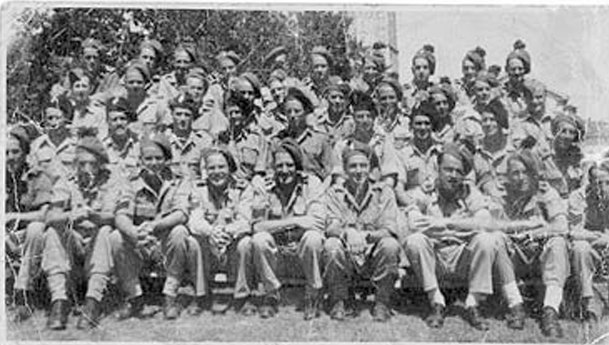
On March 29, the London Irish embarked at Taranto for Port Said, and in Egypt they went into camp at Tahag, a dreary desert waste near Quassassin, north of Cairo. That was their first real rest since before the invasion of Sicily nearly a year before. During their stay there the London Irish pipes and drums, and also a detachment of some of the survivors of the old battalion, represented it at a St George’s Day service in memory of the fallen and to commemorate the first anniversary of the 56th (London) Division going into action.
Major-General Templer, who later was promoted Lieut.-General and after the war appointed Vice-Chief of the Imperial General Staff under Field-Marshal Viscount Montgomery, took the salute in a stirring march-past. Among those who attended the service and parade was Colonel JRJ Macnamara, MP, former Commanding Officer of the 1st Battalion, who visited the London Irish later, met some of his old comrades, and learned of the passing of many more.
Relaxation for the battalion was short lived, because a company from each of the three battalions in the brigade was sent to Burg El Arab, twenty-five miles from Alexandria, to deal with a mutiny among Greek troops quartered there. This was accomplished without much trouble, and eventually the London Irish resumed the work of re-equipping and training at Sidi Bishr, a few miles east of Alexandria.
Reinforcements arrived, including many officers and men who had recovered from wounds received in Italy, but most of the new personnel was from anti-aircraft regiments whose period of usefulness in the Canal Zone was deemed to have ended with the war being removed so far away, and who had been disbanded and sent to strengthen the infantry.
Four rifle companies were again formed, and Major TJ Sweeney, who had served as Adjutant for over a year, took over D Company and was succeeded by Captain Alan Mace MC.
Much regret was felt when orders came to the brigade for the disbandment of the 10th Royal Berkshires with whom the London Irish had served since the formation of the brigade in England. The greatest friendship existed between the two battalions, and many officers and men of the Royal Berkshires volunteered for transfer to the London Irish, including Major DAT Brett, who later became Second-in-Command of the battalion, Captain R Hedger MC, and Captain AD Blake, each of whom commanded companies in subsequent fighting. A battalion of the Welch Regiment came into 168 Brigade in place of the Royal Berkshires. The battalions were now Irish, Scottish, and Welsh, a new form of international brigade!
The Regimental band, pipes, bugles, and drums, under the direction of Pipe-Major Franklin and Bugle-Major Taylor, continued to make an excellent reputation, both in Cairo, where it played at several important ceremonial parades, including that for the King’s Birthday and on Empire Day, and at Alexandria, where it played at hospitals, the racecourse, and elsewhere.
The Commander-in-Chief, Middle East, General Sir Bernard Paget, visited the battalion during an arduous training period at Burg El Arab, and expressed himself very well pleased with all he saw.
On July 12, 1944, the 1st Battalion embarked once more for Italy, and on the voyage Major HCS Lofting, the very popular OC of B Company, who had been with the battalion since Territorial days, and had been wounded twice, died and was buried at sea.
Taranto was a pleasant sight when the 1st Battalion reached it after an uneventful voyage in mid-July 1944. The harbour was full of ships flying the White Ensign, while masts and rusty hulks stood forlornly in the water, grim relics of that navy of which Mussolini was wont to boast.
A strangely familiar sight met the London Irish as they lined the sides of their ship waiting to disembark. They saw men already ashore wearing the caubeen and hackle. They were men of the 2nd Battalion, waiting to return to Egypt. There was only time for a wave and a shout, and the ways of the two battalions parted for many long weary, bitter months, until they took part in the last great race through northern Italy.
The transit camp at Taranto was five miles away, a hot, dusty, thirsty march to men in full kit on a summer’s day. The camp was an unpleasant place, dirty as only a transit camp can be, with far too few tents, little water, and bad sanitation. However, most of the London Irish were seasoned campaigners and did not worry over-much, except to request more and more tents, swill bins, and all those little necessaries which make or mar a camp. The battalion could well claim that it was a cleaner, sweeter place when they left it than it was when they arrived.
The march up was trying enough, but it was particularly galling to the London Irish to find out that they were to be the last of the seventeen thousand men who were to be fed that day at one vast cookhouse. By the time their turn approached the cooks were exhausted, the Italian servers had gone borne, and the timetable had slipped badly. The London Irish waited with patience until like the cooks’ it was exhausted, and with a creditable imitation of Nazi technique, and led by the Commanding Officer, they took over the cookhouse for its own good. The tea, at least, was hot.
A week later, on July 25, the battalion moved by train to Tivoli, near Rome, a typical war journey in slowly moving cattle-trucks. Salerno and Naples were left behind, and the veterans of the battalion were interested to know that once more they would cross the Garigliano. The crossing this time was by train and not in assault boats. Unfortunately, night fell before the river was reached, and the train’s speed increased to fifteen miles per hour, so that little or nothing could be seen. South of Rome the battalion transferred to troop-carrying vehicles, and as the journey proceeded a sense of the familiar came to officers and men as they passed Cisterna, a wreck of a town, and entered the Alban Hills, at which some of them had gazed so often and with such venom when they were straining to hold the Anzio bridgehead. And so they reached the rolling farmland near Tivoli, with Rome not far away, and the smelly but invigorating sulphur baths close by.
Rome enchanted everyone; if not for its ancient culture, then for its NAAFIs, its cinemas, theatres, and opera. All tastes were satisfied. The band put up a great show in Mussolini’s old haunt, the Piazza Venezia, and impressed both the Romans and our warm friends, the Americans, alike. A visit to St Peter’s and an audience granted by His Holiness the Pope was an historic event for those of the Catholic faith. It is recorded that one enthusiastic officer, not of the London Irish, was so overwhelmed by the occasion that he called for three cheers for the Pope. They were given with considerable gusto, to the apparent gratification of His Holiness, but to the evident bewilderment of the Vatican Guard.
While at Tivoli the 56th (London) Division was visited by HM the King, the first since he bade them God-speed on the eve of leaving England in 1942.
The battalion once again prepared for more real work. Security was the watchword, and divisional flashes and unit numbers were removed, and the Black Cat was painted out on all vehicles and signs. Camouflage was once more the order of the day, and the battalion moved secretly by night to Perugia and the farmlands at Assisi.
Here they had the first hint of future plans. The Gothic Line had to be broken to enable armour to “swan” across the plains of Lombardy. At Tolentino the plan was disclosed. The 5th Corps, with overwhelming forces of armour, guns, and infantry, was to smash through on the Adriatic, while the 5th Army was to forge on to Bologna and beyond. “First Stop Venice” was the theme, and then Vienna. A formidable force was augmented by men of the Polish Army and by our redoubtable cousins from Canada.
Spirits and hopes were high and no one guessed what a trap the plains would prove to be when finally, bloody and battered but victorious, the London Irish reached them.