The 1st Battalion left Messina two weeks after the 2nd Battalion, and their journey was not so comfortable or smooth running. They drove from Piedmonte to Messina in the first light rain of autumn, and it turned to a steady downpour by the time they reached port. The Commanding Officer and an advance party had gone on ahead, and Major Stopford, the Second-in-Command, had charge of the battalion and also of several hundred men from other battalions and formations in the brigade.
When he reported to the Movements office he was told they would have to remain at Messina until shipping became available. “Stop where?” inquired Major Stopford, and a staff-sergeant in the office pointed to a mud-flat, already awash and without the slightest sign even of a tent. Like so many Movements personnel, he was either indifferent to or ignorant of the problems of maintaining large bodies of men, and he informed Major Stopford that although the London Irish were likely to be there several days, they could not possibly use some school buildings nearby, and further that the few odd lorries the battalion had with them had to sail for the mainland that night.
Major Stopford records that despite the attitude of Movements, he gave orders to move the men into the school buildings and endeavoured to retain one or two lorries to hold cooking equipment. “The Navy never alters its convoy arrangements,” said Army Movements, so Major Stopford went to see the Naval Officer-in-Command. There he got an entirely different reception.
Of course you must keep your trucks,” he was told. That, he thought, was a welcome change from the inexcusable bureaucracy of Army Movements!
In a day or two he was informed by Movements that six LCIs were available for his large party. He inspected them and found that they were intended each to hold two hundred men, but two thousand men into six LCIs just would not go. The flotilla Commander confirmed that view, and together they saw the Naval Officer-in-Command. “My dear chap,” said he, “you cannot possibly go in six LCIs,” and gave orders for Malta to be signalled so that more could be obtained.
They duly arrived and the London Irish and the brigade personnel embarked. Outside Messina Harbour the Commander asked Major Stopford: “Now, where do you want to go?” They both discovered that neither had received any orders to proceed anywhere in particular. The situation of the Brigade “O” Group was also wrapped in mystery. “I gave my guess, which was Salerno, but the Commander thought it was probably Naples, which had just been captured,” said Major Stopford later. “Well, let’s go to Salerno, and then we can have a look at the Sorrento Peninsula on the way to Naples,” replied the Commander. So off they sailed, making a slight deviation to see Stromboli in partial eruption.
In the morning they approached Salerno. “Ten LCIs carrying 168 Brigade; request berthing instructions,” was the signal from the small convoy. “What have you come for?” was the surprising reply. That was too much for the Commander. “A summer holiday,” was his response!
However, the 1st Battalion landed on the mainland of Italy and marched to a camp outside Salerno.
They spent several rather damp days in a bivouac camp near Salerno, and many visits were paid to Pompeii. Vesuvius was also seen at a distance.
By this time Naples had fallen, and 168 Brigade received orders to move to an area round Caserta, just south of the Volturno. Brigade headquarters and the 10th Royal Berkshires were in the Palace, a magnificent Baroque building, reputed to be second only to Versailles for size among the famous palaces of Europe.
English-speaking guides were in attendance to show the “invaders” round the state apartments, an example of the remarkable change that had come about in the Italian mind and outlook. Yesterday our enemies, to-day our “allies.” They were, of course, following the flowing tide of the war and wanted to make sure they were not left high and dry on the rocks!
After two or three days in this area, enlivened by performances of the very popular 56th Division Concert Party, “The Cat’s Whiskers,” in a miniature opera-house within the Palace, the London Irish rejoined the division over the Volturno. The 56th Division now consisted of 167, 168, and 169 Brigades, and the 201 Guards Brigade, and Major-General GWR Templer, formerly of the Royal Irish Fusiliers, had taken over command from Major-General Graham.
By the middle of October, the Volturno River had been crossed and, supported by powerful air-raids on the railways in north and central Italy and on road transport behind the battle areas, the Fifth and Eighth Armies were pushing the Germans slowly back on the whole line from the west coast to the Apennines and across to the Adriatic.
The advance beyond the Volturno was proceeding with the 56th (London) Division on the right and the 46th Division on the left, with the 7th Armoured Division as a pivot.
On the left was flat plough-land. The main road from Naples to Rome, Highway Six, crossed the river at Capua, where the Allies had built a temporary bridge to replace the one blown up by the retreating Germans. Highway Six continued north-west across the plain for a few miles until it forked. One branch, still Highway Six, continued north and north-west towards Cassino; the other, Highway Seven, the ancient Appian Way, proceeded in a westerly direction towards the coast.
The flat country along the coast was dominated by a ridge of mountains rising to about two thousand five hundred feet from the river, and parallel to Highway Six. About ten miles from the Volturno a ridge of lesser hills, in the Calvi Risorta area, branched at right angles to the main ridge, crossing Highway Six and ending near Francolise on Highway Seven. The Germans were fighting a delaying action across both highways, concentrating on holding the high ridge on the right of the 56th Division.
It was essential to clear the ridge before the remainder of the two British divisions could make progress in the valley below. 168 Brigade crossed the Volturno near Caserta and assembled near Pignatore, while 201 Brigade carried out a series of actions, clearing the ridge on the right. The London Irish took over a forward position near Calvi Vecchia, where Highway Six crossed a deep ravine by a bridge which the Germans had destroyed. The battalion’s stay there was without incident except that any tendency to walk on skylines drew some very unpleasant attention from the nebelwerfers. On one of those occasions the battalion “O” Group was gathered round the orderly-room truck, and everyone scattered with remarkable rapidity. Luckily the “flying drainpipes” were more noisy than lethal.
The Scots Guards reached the mountain village of Rocclietta, where they had been held up by strong resistance from the Germans on the Calvi Risorta ridge. The plan was for the 1st London Irish to move at night into the hills to a gully behind Rocclietta and to attack the next day through the Scots Guards. The Royal Berkshires were ordered to attack farther along the ridge towards the highway, both moves having the support of the divisional artillery. The first part of the plan involved a night march up a steep goat-track. It was a precarious journey in single file, when no body of troops is well prepared for battle. Except for an odd patrol or two there were no troops on the left flank between the London Irish and the enemy, hut the march went off well, in complete silence, which was essential.
The attack was timed for the next morning, but when the London Irish went in it was found that the enemy had withdrawn under the weight of the gunners’ fire.
Going into brigade reserve the battalion spent a few days south of the hills while preparations were made for the next move forward. American troops advanced towards Cassino on the axis of Highway Six, while the 46th Division moved parallel to the coast along Highway Seven. The 56th (London) Division was given a route along a secondary road through Teano to Roccamonfina. This village was at the foot of a large, wooded mountain, Monte San Croce, which overlooked the lower reaches of the Garigliano River. To reach it a winding road with innumerable gullies and bridges had to be traversed.
The first objective along the road was Teano, and as the London Scottish advanced towards it they met a good deal of opposition. The London Irish were given the job of capturing high ground to the east and overlooking the town, after which the Royal Berkshires were to press through towards Roccamonfina.
During a preliminary reconnaissance near a fork on Highway Six the area was bombed with some violence by American dive-bombers, causing a few casualties. On protesting to higher authority, the London Irish were not much appeased on hearing that the road-fork had been mistaken for another thirteen miles away!
After several changes in plan the attack was made, and the London Irish reached the high ground east and north of Teano. It had been held by a strong German rear-guard, some of whom were captured. The London Scottish entered an abandoned Teano, while the London Irish moved over the hills to the main road below, and the Royal Berkshires took Roccamonfina. The plan had gone very well, though there was some delay caused by enemy demolitions. They had done these with typically German thoroughness. Dozens of small bridges had been destroyed, and hundreds of trees had been felled over the roads, but the Pioneer Platoon of Headquarters Company under Lance-Sergeant W Woolf worked magnificently in removing mines and booby traps.
It was during the battle of Teano that tactical headquarters of the battalion was bombarded by enemy mortars, machine-guns, and by a thirty-seven-millimetre four-barrelled flak gun. With admirable coolness, the Adjutant, Captain T Sweeney, the Intelligence Officer, Lieutenant S Sharp, and their staff carried on. This steadiness under fire and devotion to duty – which throughout the Italian campaign was shown by all ranks at forward headquarters – was a notable contribution to the battalion’s success.
Enemy guns also shelled the vicinity of the observation-post held by Captain LH Crocker, of the 408th Battery of the 146th Field Regiment R.A. (Royal Cardiganshire Yeomanry), on the forward slopes of the ground captured by the London Irish. Though exposed to German fire, particularly from the flak gun at short range, Captain Crocker directed the fire of his battery until the enemy guns and mortars were silenced. For his courage and outstanding coolness, which was of the utmost value to the London Irish attack, Captain Crocker received the MC.
As the division went forward the country, with its gullies, hills, and ravines, aided the enemy in their steps to delay the advance. Progress by the Allies seemed slow to the outside world, but it had to be won with great effort on the part of all ranks, and not without losses.
The next job for the London Irish was to advance through Roccamonfina and to capture Sipicciano, a village on the northern slopes of Monte San Croce and overlooking the valley before Monte Camino. It involved a trek along a mountain track on the slopes of the mountain. Enemy rearguards were brushed aside in a brief action by B and C Companies, and as the sound of Spandau fire echoed through the woodland it was difficult to know where the main body of the enemy was. Colonel Good called a halt, his intention being to rest battalion headquarters for five minutes, but the pause actually lasted a month!
The general situation had become obscure. We held a bridgehead in the valley, and in front was Calabritto with the vast mass of Monte Camino above. Towards the left could be seen the Gari River, which became the Garigliano after merging with the Liri River. Far beyond was the great white bulk of the Monastery of Monte Cassino, with Monte Cairo towering behind. The whole panorama was one of bold grandeur, and no one then knew that they were looking at what became one of the bloodiest battlefields of the war, where many thousands of brave men died.
Before us loomed the Gustav Line, which was regarded by the Italian Staff College as a perfect defensive position. Monte Camino was the outer bastion, and this had to be captured before any attack could be launched on the Gustav Line itself.
It was now November 3, 1943, and the Italian winter had settled in. This belied for ever in the minds of the troops the slogan “Sunny Italy.” Living in the open, two thousand feet above sea level, they learned to their cost that the Italian rainfall was a good deal heavier than our own.
The advance towards Monte Camino was complicated by the absence of decent roads, and as the stop at Sipicciano lengthened, the track there became a major supply-route and required constant rebuilding, all of which took up valuable manpower.
Meanwhile, it was necessary to find out what was happening on the left flank. Lieutenant Morley Mower, a fluent Italian speaker, was sent on a patrol to find the nearest unit in that direction. He was away all night, and his absence caused some anxiety, but he turned up next morning full of information gathered from the local inhabitants. He ascertained that there was no unit on the left for several miles.
The next vital stage in the fighting on this part of the front was to be the capture of Monte Camino, a gigantic task calling for the highest possible courage and planning. The London Irish had to reconnoitre the route, and it became a period of patrols to gain information in readiness for the attack. The battalion took up positions in the vicinity of Sipicciano, with battalion headquarters in the woods where earlier they had halted for “five minutes.” Most of the patrols were carried out by Captain John Strick and his battle patrol. In England he had trained “X” Platoon, a small body of picked men expert in scouting, field-craft, and commando work, with a view to possible raids across the Channel. While at home that opportunity had not come, but here in Italy Captain Strick and his happy and faithful band of warriors proved their worth.
Captain Strick had been slightly wounded in Sicily, but after a spell in hospital he had returned to command the Carrier Platoon. When orders came to form a special battle patrol, he was obviously the man for it, and he selected all those who remained of his original “X” Platoon.
Now, facing Monte Camino, Captain Strick and his men carried out a number of daring and hazardous patrols, sometimes going out on to the mountain for two or more days, closely observing enemy movements and positions.
On one occasion he went out with only three men to ascertain whether the Germans still occupied a hamlet in the hills and to note their defences. With threatening rainclouds scudding over the mountain top the party set out. All went well for two hours. They slid down precipitous cliffs, scrambled on all fours like mountain goats across steep slopes when a slip almost certainly would have meant death, and sometimes they were forced to crawl. Then the clouds burst. It rained in torrents, and as there was no cover they were soon drenched.
Bruised and scratched, they managed to snatch a short rest at occasional clumps of gorse and eventually reached a wooded gully where they could take a longer breather and get on their feet.
While they were resting the small party heard running footsteps. They fell quickly to the ground, and a German crossed their path only a few feet away. He did not see them, and after he had passed the patrol crept forward stealthily and discovered an enemy mortar post fifty yards away. It was apparent that not only were the Germans still in possession of the village, but that it was well and cunningly defended.
Without being discovered they completed their survey of the German positions and started their equally perilous journey back. The outward trek had taken them five hours, but with the advantage of having passed over the ground before their return was a little faster. They slithered down gullies and slopes and, wet through but remarkably cheerful, they reached their company lines and after a report had been sent through, they had the satisfaction of hearing the German posts being thoroughly pounded by the divisional artillery.
During another patrol, which was out for thirty hours, Captain Strick was wounded in a clash with a small party of Germans, but the enemy were forced to flee and the patrol got back. Among the members of Captain Strick’s intrepid band of adventurers were Sergeant G Murphy, Lance-Corporal J Short, Rifleman William Scott, and Rifleman Jack Armstrong, his batman. Several of them later were killed in action.
The first attack on Monte Camino took place in November 1943 and was carried out by 201 Guards Brigade. The attack started from the positions of the 1st Battalion London Irish in the vicinity of Sipicciano, and despite very gallant efforts the Guards were unable to complete their task. It was a stupendous one for a single brigade and eventually they were withdrawn. Their magnificent fight was in the Guards tradition, and though they were ordered back they did so coolly and methodically. Some of the ground they had taken at the foot of the mountain was held, and it became the jumping-off place for the second attack.
During the whole of November, therefore, the 1st Battalion remained around Sipicciano. There was some shelling, but casualties were light. Visiting the companies on their wide front was a lengthy job and involved traversing open ground, which often drew mortar fire. This was more disturbing than accurate.
Announcement was made at this time of Lieut-Colonel Good’s DSO, which he had been awarded for the action on Catania Plain. The irrepressible Corporal Newcombe, familiar to all 1st Battalion men as “Corporal F.,” the Post-Corporal and Piper, decided to obtain the necessary ribbon for the decoration. Inquiries at division were fruitless, but a journey to corps headquarters brought news of a Brigadier with a DSO. How he negotiated the matter with the Brigadier’s batman is not known, but “Corporal F.” obtained a DSO ribbon from one of the Brigadier’s tunics and he presented it to the Commanding Officer.
The month was very wet, and the battalion still lived in “bivvies” in the open. The most common bed was leaf-mould, which though soft was seldom dry. Sleep of necessity was short, because of the need regularly to “stand-to.” If one did not happen to be on duty in the period immediately before, to get up needed considerable effort. That, of course, was part of the routine of a soldier’s life and applied to all ranks.
News then came that the 56th (London) Division had been selected to take part in a further attack on Monte Camino, the operation coinciding with an attack by the Americans on the twin feature of Monte la Difensa.
Monte Camino, rising a sheer three thousand feet from the surrounding valleys, was crowned with a small monastery, and the whole feature was about six thousand yards wide and seven thousand yards in depth. The Americans were on the north-east section and the British on the south-east. The mountain was rocky, steep, and bare, and on the British side the only approach for laden men was up a steep, zigzag mule-track leading from a village called Mieli. The existence of this track was well known to the Germans and was marked on all the maps. On the western side Monte Camino was less steep, and on the German side it sloped down to the Garigliano River. Rocca D’Evandro, a village connected by a twisting road to the valley below, was on the western side. This road was invaluable to the enemy because they could transport supplies by lorry, while our so-called mule-track was largely too steep and rough even for mules, and everything had to be manhandled. A patrol base was established in the Mieli area, and on one occasion Rifleman W. Garrod, a mechanic in the transport section, escorted three bantams carrying rations to the patrol. While leading the way in the darkness his motorcycle and two of the bantams drove into a large shell crater filled with water. The trucks were immobilised by the water, but Rifleman Garrod repaired the damage in the dark and they set off once again. The rations got through.
The second attack on Monte Camino was timed for December 3. 169 Brigade (The Queen’s) was to attack the Monastery Peak on the east of the feature and a knife-edged spur leading south from it. 167 Brigade was to go in north and north-west from Mieli, up the axis of the mule-track, with 168 Brigade passing through later. 201 Guards Brigade was to capture the south-western part of the mountain. At the same time the 46th Division had to clear the low ground to the south-west, while the Americans, on the right, tackled Monte la Difensa. In the first part of the operation the London Irish were placed under the command of 167 Brigade.
The attack opened with a tremendous shoot by the gunners, which was the biggest bombardment since El Alamein. Everything passed overhead on to known enemy positions. The night was lit up by Bofors tracer and the cannonade from six hundred guns brought a lurid glare to the sky. General Mark Clark subsequently observed that Camino should be called the “Million Dollar Mountain” as so many shells were fired at it. The total was estimated at one thousand three hundred tons, an amount of explosive equivalent to a major air-raid on Berlin or another large German city.
The fight was a bitter one. The infantry had an almost super-human task for, despite the terrific bombardment, the Germans held on grimly to their mountain fortress. In the darkness and in drenching rain the heavily laden infantry slowly climbed the wooded lower slopes of the mountain towards the rocky barren crests. Above them the enemy sheltered in entrenchments which had taken weeks of forced labour to prepare, and in machine‑gun posts which had been excavated out of solid rock. Lightly equipped fighting patrols went on ahead and the assault troops followed. Air and long‑range photographs of the mountain had been studied in great detail, and the way upwards had been carefully planned to a time‑table. One complete brigade passed through a narrow gap in single file. There was only room for one man at a time, but the long approach climb was carried out as planned and almost to the minute. Jumping‑off places for the assault were below the jagged peaks. There was some cover, but it was impossible to dig in. Rough sangars were hastily built, but they were inadequate against the enemy’s fire and many men were hit. The attack went in and the Germans resisted fiercely. Small vantage‑points were gained after bloody combat, but progress was slow. Almost every yard might cost a life. For eight days everyone clung on. Rain came in torrents and the nights were intensely cold. Gradually a strangle‑hold was obtained when the Allied troops took vital ridges overlooking the German supply‑lines. The London Irish did their part. A Company captured Formelli, a small village on the track to Rocca D’Evandro, the Germans’ supply artery. 201 Brigade and 169 Brigade manfully made frontal assaults among the heights, and when the American 11th Corps secured most of the Monte la Difensa, it was the beginning of the end.
Captain DA Gibson, of the London Irish mortars, directed and co‑ordinated the mortar fire of four battalions in an all‑out effort to subdue the enemy on Monastery Hill. There was enemy counter‑fire, but the men at the mortars remained steady and their accurate shooting added to the gradual demoralisation of the enemy.
The defenders of the Monastery Peak realised they were losing all chance of escape and one night the monastery was unexpectedly abandoned. Within a day or two the Germans had left the whole feature. The London Scottish passed on to Rocca D’Evandro and the London Irish were withdrawn, very wet, tired, and dirty after an eight days’ gruelling attack. They had been in it longer than anyone else, though chief credit for the success of the well‑planned operation must go to the Queen’s of 169 Brigade, the Royal Fusiliers of 167 Brigade, and the Guards, who fought with great dash and spirit despite heavy losses.
The London Irish were fairly fortunate in their casualties, which totalled about eighty. Among the killed was Lieutenant Terry Barry, a capable and gallant officer. It had been a very hard battle, requiring dogged endurance, with none of the exhilaration of the quick attack. The carrying-parties had a gruelling time. Every night almost the entire personnel of A and B Echelons carried supplies of all kinds up the Mieli mule‑track under constant shelling by the enemy. It was most exhausting work and the journey took several hours. Many men did it twice in a single night, a remarkable test of stamina and endurance.
The stretcher‑bearers of the battalion again worked splendidly in succouring their wounded comrades. During the occupation of Formelli a signaller of the gunners’ observation‑post party was wounded while putting down a line on the track leading to the village. Piper E Riley and Rifleman H Hughes, the stretcher-eaters of A Company, volunteered to bring him in. German machine‑guns swept the road and twice they were forced back. Undeterred, they made a third attempt by another route, reached the wounded man, and brought him back to the London Irish lines safely.
Excellent work, also, was done throughout by the signals section of the London Irish under Lieutenant HD Miller. He led frequent parties to repair lines broken by enemy fire. Communications were vital, and when they were interrupted, they never remained so longer than could possibly be avoided.
Many men died on Monte Camino, in the two attacks. Several months later French mountain troops trained there for the attack on the main Gustav Line, and they were so impressed with the achievement that they erected on the summit a memorial to the fallen.
With the capture of Monte Camino an important change‑round took place. The 46th Division took over that sector of the front, and the 56th Division moved to the coastal sector facing the Garigliano. We were sorry to see 201 Guards Brigade leave the division, for they had been stalwart comrades.
The London Irish had by this time reverted to 168 Brigade, and the brigade went out of the line for the first time for two months.
The closing weeks of 1943 saw the battalion in billets in Cascano, a pleasant little town six miles from the Garigliano. The billets were poor in themselves, but luxuries to those to, whom a roof and a dry room were a palace. The second Christmas overseas was enjoyed there, and Captain Bonham‑Carter took the opportunity of presenting the battalion concert party, the “Liricals,” in an excellent show, the chief memory of which was the leader representing the Spirit of Monte Camino and singing a song that ” They’ve put ‘S’ mines at the bottom of my garden.” It was indeed extraordinary that in between bloody and fearsome battles, in which they played their full part, the men of the concert party could produce topical jokes and sketches and sing and dance. That, perhaps, is a gift peculiar to the British.
Throughout its war service the battalion was deeply grateful to Captain Bonham‑Carter and his assistants, notably the “Two Twerps” (Sergeant S Handcock and Sergeant E Thurston), CQMS Robinson, Corporal Hone, Rifleman Odell, and the other members of the concert party, who spent so much of their leisure hours working on behalf of the men of the battalion.
Reinforcements came to the battalion, and among the changes at that period were the appointments of Major WE Brooks, MC, as Brigade Major, Lieutenant S. Sharp as Brigade Intelligence Officer, Major Cummings taking over C Company, Lieutenant A Mace, Battalion Intelligence Officer, and Captain Crozier succeeding him as Mechanical Transport Officer.
In a special message to all ranks in the battalion, the Commanding Officer, Lieut‑Colonel Good, spoke of the two exacting trials which the battalion had undergone during the month. The first was the holding of the Sipicciano position, a long, rather inactive task under most trying conditions of weather. Owing to the wide deployment of the battalion it was not possible for much rest to, be obtained by any individual.
“With hardly a break the battalion was then committed to a mountain operation of a most exacting nature,” wrote the Commanding Officer.
Quite apart from the physical strain of this operation combined with the most appalling weather conditions, the role of the battalion in reserve to 167 Brigade meant that our tasks and orders changed rapidly with a changing situation. As it turned out, at no time did we have the satisfaction of having a task to do and completing it to, our own satisfaction and knowing that we had achieved something definite and tangible. All the time we had to sit and ‘take it’ from enemy artillery and mortars without being able to, do very much in return. I know of no harder test of any unit.
I have been most impressed with the magnificent way the whole battalion has come through these tests, no matter what the conditions of weather, shell‑fire, and so on were. Companies, platoons, and individuals stuck it and stuck to their job without flinching. The Brigade Commander has told me, too, how very impressed he and others have been with the cheerfulness and willing spirit apparent throughout the battalion during the whole period.
I would like to give a special word of praise to the mortars. I am quite convinced that their accurate shooting on to Monastery Hill during the day when the Huns finally abandoned it had a great deal to do with the final quitting of that feature by the Huns. A very special word of praise and thanks is due, too, to, those from Headquarters Company, A and B Echelons, who did porter duties up the hill night after night. They were grand, and we should be more than grateful to them for their efforts.
To all of you I should like to express my heartiest congratulations and grateful thanks for the way you have carried oil, keeping the traditions of the London Irish Rifles right at the top, where they should always be and where 1 have no doubt they will always remain.
We have not yet quite finished with this party, but I hope that we shall get a period of proper rest soon. Meantime I am sure that anything we are called on to do we can do, and that better than anybody else.”
Nineteen Forty Four was the bloodiest year of the war for the 1st Battalion: its ranks were sorely depleted by heavy losses on four occasions. First at Castelforte, in the period now to be recounted, twice at Anzio which followed, and then during the long, bitter struggle for the Gothic Line.
On New Year’s Day they went back into positions on the south bank of the River Garigliano. Battalion headquarters, a rifle company, and Headquarters Company were housed in the pretty little hamlet of Garigliano, hidden in the wooded hill‑side between the Sessa‑Arunca road and the riverbank. One company was on the brow of the hill immediately overlooking the river, and another was nearby at Aconorosi, with the fourth at Gualpi, a village three miles away. As the outlying companies had to live in the open with onerous guard and patrol duties, reliefs were sent forward every four days.
The battalion’s main job was to prevent any infiltration by the enemy south of the river, to observe any movements on the far bank, to reconnoitre and make safe any possible routes to the Garigliano, and to examine the area towards the mouth of the river for possible crossings.
The ground sloped steeply from the Sessa road to the bank and was densely covered with trees. Except for a few villages tucked away in the woods, and an isolated farmhouse or two, the country was uninhabited. There were neither roads nor tracks, apart from the main road, but only dry water‑courses strewn with boulders. These courses were sometimes wide, but at other times so steep and narrow that it was possible to touch both sides with ease. Garigliano was completely screened from German observation and the paths down to the river from the London Irish side were almost entirely under cover. On the other hand, excellent views of the German positions could be had from “grandstand garrets” in the top stories of the houses in Garigliano and Aconorosi. One important part of the riverbank could not be seen and that was why a rifle company was stationed well forward.
The entire donkey force of the villages was requisitioned to carry supplies, and also the company quartermaster sergeants on their rounds. The Commanding Officer, the Adjutant, and Lieutenant Mace, the Intelligence Officer, walked many miles each day, usually before breakfast, and they too might have journeyed on donkeys, but Colonel Good was far too tall. It was quicker and more comfortable in his case to walk.
Captain John Strick, the leader of the battle patrol, carried out several day‑time reconnaissances in full view of the enemy by the simple method of dressing as an Italian peasant and wandering occasionally with natives along the banks of the river.
Mines left behind at odd places by the Germans proved a nuisance, and before the assault crossing of the river caused more casualties than enemy fire.
The plan for the operation was for the 46th Division to attack on the right and capture high ground beyond the river; the .5th Division, which had been transferred from the Adriatic front, was to move on the left; and in the centre 167 and 169 Brigades were to cross through 168 Brigade, which was to follow them over.
On the 46th Division sector the hills rose straight from the river; on the other two sections there was a plain between one thousand and three thousand yards deep before the ground rose sharply. This plain extended for about ten thousand yards from the sea on the west.
The German plan, as was learned later, was to hold the low ground comparatively lightly, sow it extensively with deeply buried box‑mines which consisted of little except wood and explosive, thus giving hardly any response to mine‑detectors and to hold positions on the high ground behind. From there they could observe the projected crossing‑places along the river below.
Dominated as it was by enemy‑held mountains and foothills in the background, the plain was barely wide enough to concentrate a large force. In fact, no such force was available for the operation. It had been devised by High Command to coincide with the landings on the beaches at Anzio, which were intended to draw troops away from other fronts in Italy.
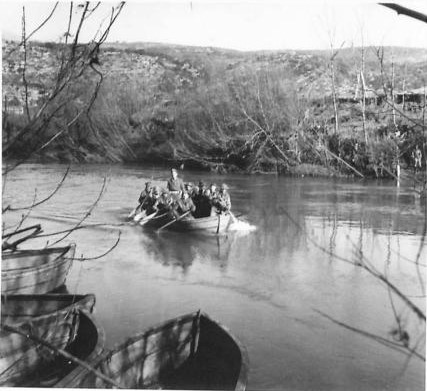
The assault began at 2100 hours on January 18. A small red ball floated across the still, star‑spangled sky and landed gently as thistledown on a German post over the river. That was the signal. Five hundred guns. of all calibres thundered a terrific bombardment. Under cover of a smoke‑screen and with covering fire by men of the London Irish and other supporting troops, the Queen’s Brigade and 167 Brigade swept across, some of the latter in assault boats manned by men of the battalion. As the British troops neared the opposite bank German eighty‑eight’s spat viciously overhead or in the river. On the south bank mortars kept up a bombardment in close support; the three‑inch mortar platoon of the London Irish, under Lieutenant DA Hardy, alone fired over six hundred rounds in less than sixty minutes.
The river was fifty to one hundred yards wide and was running strongly and fast, owing to the winter rains. It was far too swift on the right, where the banks were precipitous, so that the 46th Division was unable to land. The crossings by the 56th (London) Division and the 5th Division, farther down the river, went according to plan. By dawn on the 19th a bridgehead had been forced, including the small town of San Lorenzo which guarded the approaches to Castelforte and the valley beyond. On the evening of that day German reaction developed and the London Irish were suddenly sent across to help make 167 Brigade’s landing secure, to occupy San Lorenzo, and to prepare to attack Castelforte at once.
Rising above the river in front of the 56th Division was Monte Damiano, with lower spurs running south and east. In the heart of the hills north‑east of Damiano, was the small town of Castelforte, which was connected to the valley below by two nearly parallel roads. In the valley was a third road along the lower edge of the mountain. Where the roads from Castelforte met this road stood San Lorenzo.
The Commanding Officer and his “O” Group, crossing ahead of the battalion established themselves in a farmhouse about a thousand yards from the banks and roughly midway between the river and Monte Damiano. The house was well observed by the Germans, and consequently it was heavily shelled. Several direct hits were made, but it had thick stone walls and suffered surprisingly little damage.
Battalion headquarters of the Oxford and Bucks was housed there also, and there was a certain amount of confusion with two staffs in conference at the same time, and with dispatch riders and runners coming and going. There was an animated scene which added to the chaos when an officer discovered he had lost his only pair of blue silk pyjamas and suspected he had been robbed. A search of the building was made, and even the kit of other ranks was examined, but the garment was never found, and the officer had to sleep in his pants until such time as he managed to acquire another pair.
The main body of the battalion crossed the river and harboured in various farms near the river, waiting for orders to attack Castelforte. They came under shell and mortar fire, and Major H Lofting, commanding B Company, was wounded. Captain Bonham‑Carter took over the company. Shelling continued while the work of getting supplies over followed. This job was a pretty tough one, for the enemy were doing their utmost to prevent a build‑up in strength. The ground from the river was, pitted with shell holes, and the men scrambled and struggled up the slopes with their heavy burdens.
A strong patrol led by Lieutenant Mills went out about midnight with orders to clean up Castelforte prior to the continued advance by the brigade. Higher Command believed that the town was held only by rear‑guards.
The patrol went along the right‑hand road from San Lorenzo .and met strong opposition on the outskirts of the town. Lieutenant Mills sent back all the patrol except himself and three men and decided to remain and find out all he could about the German strength in the town. He was wounded but managed the following night to stumble into the headquarters of A Company, where he made his report. Covered with blood; and wounded in several places, he gave an outline of what he believed was the position and revealed what had not been known before‑that the enemy had brought up some tanks into that difficult locality. The three other men did not return. Captain Strick then went out with his battle patrol on a further reconnaissance of the enemy’s positions, and this time they avoided both roads and cut across the hilly ground in between. With two non‑commissioned officers and six riflemen, Captain Strick set out at one o’clock in the morning and in the moonlight got to the outskirts of Castelforte in an hour, which was very good progress. At the first block of houses Captain Strick passed down a side street, hoping to get round to the other side of the town without being seen.
It was suspected that the houses were full of booby traps and mines. The patrol halted at a road junction and divided, Captain Strick going in one direction with four men and the others in another. Suddenly there was a loud explosion, and they all threw themselves to the ground. They thought they had been discovered and that a hand grenade had been thrown. A quick look round revealed that some of the party had been hit by a mine. The patrol sergeant, Sergeant G Murphy, was killed, another man was badly wounded, and Captain Strick had injuries not so serious to his arms and side. The wounded man was hurriedly attended and left under the protection of some trees. Captain Strick, despite his wounds continued forward cautiously with the remaining adventurers. At one time they heard German voices, and as they carefully approached what they took to be the main street of the town they saw a large body of Germans marching along. They had a further quick look round and were satisfied that Castelforte was held in considerable force, and not by just a handful. Then, as Captain Strick was beginning to feel the effects of his wounds, they set off on the return journey. They found the wounded man propped up against a tree, calmly smoking a cigarette. They put him on a ladder and carried him to a house nearby. Luckily, they were clear of the German positions, but instead of being empty, they found the cellar of the house filled with men, women, and children, all natives of the town, who had sheltered in one of the few buildings not demolished by the artillery bombardment.
They had refused to leave and had preferred to run the risk of staying in “no‑man’s land” while the battle swirled past. They were able to give Captain Strick valuable information about the mines and traps in the area.
The patrol then left, rejoining the second party, who also had succeeded in avoiding the enemy, and they returned safely to headquarters with their mission accomplished.
In spite of the reports from the London Irish patrols the capture of Castelforte was still regarded by higher authority as a minor operation, and that only one company, or at the most two, should make the attack. Colonel Good decided to attack with two companies; C Company under Major Cummins to proceed on the flank west from San Lorenzo and to take advantage of cover from the woods on the lower slopes of Monte Damiano, while A Company on their right, under Captain Grace, was to attack from the south. D Company was to cover the other companies from the higher slopes of the mountain.
D Company reached their objective and dug in by scraping about eighteen inches of earth from among the rocks and building stone sangars round the shallow holes. They proved rather uncomfortable shelters, as shell and mortar bursts caused not only metal to fly but also a hail of chipped rock.
The attack started at 1100 hours in daylight. The line of advance was incredibly difficult for everyone. The slopes of Monte Damiano were terraced with steps of chipped stone and packed earth, each six to eight feet high. The flat terraces between each step were covered with dense trees, through which the troops had to struggle.
Major Cummins got as far as he could with his men and then went forward to observe the enemy. It was obvious that the Germans were well prepared and on the alert. They intended to stay until they were forced out by overwhelming strength. There were tanks and self‑propelled guns in close support of their infantry. The small reconnaissance party from C Company was discovered, and in a brush with an enemy post Major Cummins was wounded and was unable to regain contact with his company.
As both A and C Companies had reached a point where they were almost exposed to view from the town and any movement attracted the German gunners, it was considered unwise to attempt any further advance by day.
A night attack was arranged. This began at 0100 hours, after an artillery preparation which had opened fifteen minutes too soon. It was understood that the London Irish attack would synchronise with one by a battalion of the Queen’s from the north and farther up the river. That proved not to be so.
Captain W Byrne, who had assumed command of C Company, launched his men forward unsuspectingly and the company ran into a strong force of Germans hidden in a wide ditch. The enemy allowed most of the company to pass by and then opened up with small arms. The forward sections of the company were killed or captured, but the remainder managed to extricate themselves in the darkness.
A Company, on the right, also had a bad time. As they crawled through the enemy wire and mine‑fields, the Second‑in‑Command, Lieutenant Crampton, trod on an “S” mine. Instead of throwing himself down as trained to do and in that way possibly escaping personal injury, he kept his foot firmly on the mine. This delayed the mine’s jump in the air before it exploded. Lieutenant Crampton called out to everyone round him to get down, and as they did so the mine blew up on the ground, destroying one of Lieutenant Crampton’s legs.
His action undoubtedly saved the lives of several men near him and was a fine example of cool, calculated courage and lightning decision. Lieutenant Crampton remained seriously ill for some time but fortunately recovered. He was awarded the George Medal for his action.
The rest of the company moved on into the south of Castelforte and got there just before dawn. Contact with them then was lost. Their wireless broke down and runners were unable to get through. For twenty‑four hours there was no word, and as a party was being organised to go to their aid, a faint call was picked up by signallers at Tactical Headquarters. It gave A Company’s call sign, but it could only just be heard. It indicated that at least one member of the company was still alive.
An hour or so after dark on this second day a patrol, consisting of a non‑commissioned officer and two riflemen, reached Tactical Headquarters from A Company. They told a remarkable story. It appeared that when Captain Grace had realised he could not continue to advance along the line of the upper road from San Lorenzo, he turned back and worked his way with his men along the right‑hand road to Castelforte. All went well until they reached the edge of the town, when for the second time they ran on to a mine‑field. Captain Grace and a few others were wounded, but they all managed to get into two unoccupied houses on the fringe of the town before light came. Though they were completely surrounded by Germans no one came near them, but they had a nasty shock when two enemy self‑propelled guns drew up alongside and fired some rounds towards the river. The enemy did not suspect that they had a party of the London Irish in their midst. German soldiers went in and out of other houses in the vicinity, but no one came near A Company. Had they revealed their presence they would, of course, have been at once wiped out.
When night came again, the patrol who told this story bravely made their way back to the beleaguered men and very stealthily the depleted company were guided back to the London Irish lines.
The enemy now gave further proof that they intended to hold Castelforte and perhaps to throw the British troops back over the river. Counter‑attacks were launched all along the north bank. D Company on Monte Damiano and B Company in and around San Lorenzo were shelled heavily. Tactical Headquarters was hit, and among the wounded were Major Alec Smith, the able and energetic battery commander of the 65th Field Regiment RA, and also Sergeant Thurston of the signals section. One shell bursting on the terraces destroyed a day’s precious water supply.
On Monte Damiano D Company Headquarters also got a direct hit, and Captain Sir James Henry, the Company Commander, was, seriously wounded. Another casualty was CSM McDaid. The company positions were heavily attacked, and in close fighting Lieutenant Morley-Mower was killed. The men fought on under Lieutenant Spiller and Sergeant Alf Fry, a splendid non-commissioned officer, whose death later at Anzio was a loss to the battalion. The attack was beaten off, and Sergeant Fry’s fearlessness was an example to all those under him.
Major Mahon, the Officer Commanding Headquarters Company, was sent up to Damiano to help with a composite company from headquarters, and the position was held. One of the members of the signals section, Lance‑Corporal F Norman, was wounded in the arm and leg while serving with D Company on Monte Damiano. His wireless set was damaged, but despite his, wounds and the appalling weather on the mountain‑side he crawled from one slit trench to another and found another set. He crawled back with it but found that it would not work. He calmly stripped both sets and with parts from each got one set to operate. Communications with battalion headquarters were resumed, and he was then sent back to the regimental aid‑post for treatment. After his wounds had been dressed, he noticed that headquarters, were woefully short of signals personnel, so he quietly settled down to work there. It was not until he was wounded again by enemy shell‑fire that he was forced to give up and was sent to hospital. For his bravery and outstanding devotion to duty Lance‑Corporal Norman received the DCM.
The hard fighting continued, and there was tense hand‑to‑hand combat among the sangars and terraces above and in the woodlands below. Farther along Monte Damiano the enemy pressed, but Colonel Baird’s men held firm.
All the troops who crossed the Garigliano up to that time had with them only light weapons which they had carried in the boats or rafts. In but a few instances could vehicles such as heavy mortars and anti‑tank guns be ferried over. At San Lorenzo a few tanks managed to get across, and they helped in its defence. In this battle a rather depleted A Company under Lieutenant Ray Mullins (later Captain Mullins) joined B Company, and when the enemy Panzers tried to force their way through from Castelforte they got an unexpectedly warm welcome and were compelled to turn back. During this fighting Captain Bonham‑Carter was wounded.
A fourth day was spent in holding the bridgehead. A Company joined the gallant garrison on Monte Damiano, and slowly the German effort spent itself. They had suffered very heavy losses with little result, and the Garigliano crossing was secured. Three bridgeheads were made on a seven‑mile front and within a few days they had been enlarged to a depth of two miles. The attacking divisions, the 56th (London) Division and the 5th Division, had attained their main objectives and held them against the fierce reaction of the enemy, but there were no fresh troops immediately available to pass through, the 46th Division having already been called in. A pause, therefore, had to be made.
Casualties on our side had been heavy and the London Irish, now sadly weakened, were relieved in the line by the Hampshires of the 46th Division. They went back across the river to Sessa Arunca to rest. While there, news came that Lieutenant Ralph Budd, a former first‑class non‑commissioned officer who rose from the rank of rifleman in the early days of the war to the rank of CSM, and was commissioned in the field, had been killed in his first action as an officer with the London Scottish. Two London Scottish sergeants had been attached to the London Irish on being commissioned. One of them, Lieutenant Henderson, served with C Company and died of wounds received at Castelforte; the other, Lieutenant Butch Valentine, was wounded in the fighting with B Company at San Lorenzo.
Throughout the battle for the Garigliano bridgehead every man in the battalion had played his part. A and B Echelons again accomplished an almost superhuman task in getting food, water, and ammunition to the forward companies. Every single box of ammunition and can of water had to be carried by hand to the men of A and D Companies on the top of Monte Damiano. Climbing the many terraces by day unencumbered was hard enough, but to do it by night, heavily burdened and sometimes under fire, was a magnificent achievement. Never once did the men in the forward lines go short. Great and valuable work was done also by the native African troops who did portering duties during the operation.
The London Irish casualties were twelve officers and about a hundred and eighty other ranks, and in a message of commendation to the battalion Lieut-Colonel Good said the Divisional Commander and the Brigadier had expressed their sorrow at the losses sustained but that the battalion had responded splendidly to the calls made upon it. “Now we must lick our wounds and get ready for the next bout as quickly as possible, making sure that we maintain and enhance the high name of the London Irish Rifles under all circumstances,” wrote the Colonel.
Plans were made for another attack on Castelforte and in six days the battalion once more crossed the Garigliano. All was being prepared for action when suddenly the telephone rang at battalion headquarters. The Commanding Officer answered it and turning to the Adjutant said: “It’s all off, we are going to Anzio.”
The battalion left the Garigliano sector and went to Capua. New officers and men arrived as reinforcements, but there was no time for them to settle in or even do any training. A strangely new and loosely knit battalion then set off for another sanguinary battlefield – the beachhead at Anzio.