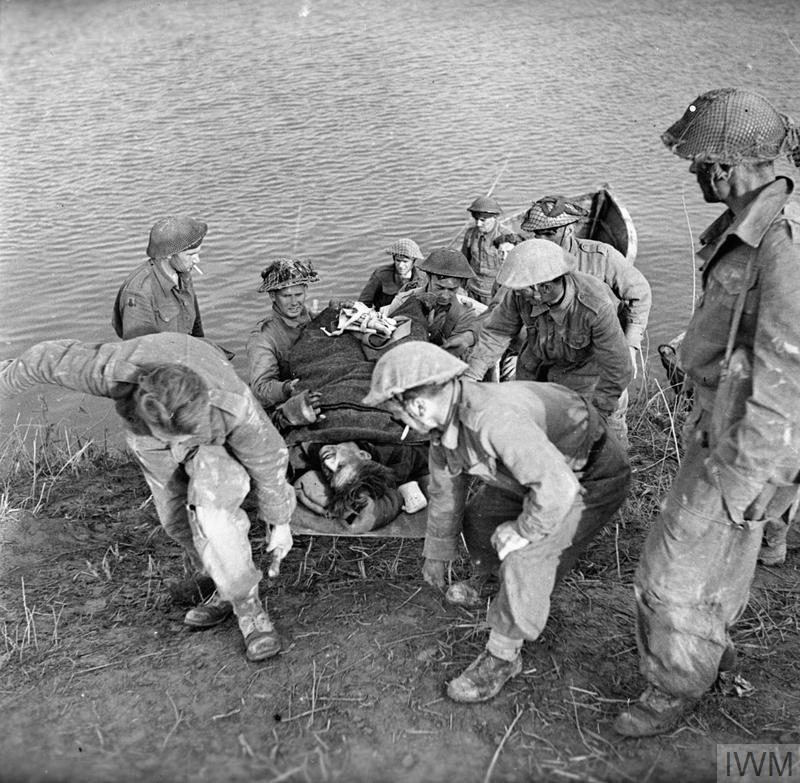
On April 2 the 1st Battalion left its rest area and after an all-night drive through Forli and Ravenna concentrated at San Alberto, a little village on the south-west corner of Lake Comacchio, where the Reno flows alongside the lake. The enemy were a mere one thousand yards away, and elaborate precautions had to be taken by the London Irish to keep their presence secret. That was a comparatively simple matter, owing to the Germans’ lack of aircraft and to the fact that though the ground was flat and swampy, there were sufficient buildings and cover to hide both troops and vehicles.
The Reno was fairly slow-moving, about twenty yards wide in most places, and it passed along the southern shore of Lake Comacchio to reach the Adriatic three miles east of San Alberto. It was bounded throughout by artificial flood-banks, similar to those on the Senio, in which the Germans had built an elaborate system of dug-outs and formidable fortifications. The work had been carried out by the Todt organisation many months before and steadily improved during the winter.
All was now ready for the main offensive, and in a Special Order of the Day to all troops the Supreme Allied Commander of the Mediterranean Theatre, now a Field-Marshal, said:
“SOLDIERS, SAILORS AND AIRMEN OF THE ALLIED FORCES IN THE MEDITERRANEAN THEATRE.
“Final victory is near. The German Forces are now very groggy and only need one mighty punch to knock them out for good. The moment has now come for us to take the field for the last battle which will end the war in Europe. You know what our comrades in the West and in the East are doing on the battlefields. It is now our turn to play our decisive part. It will not be a walkover; a mortally wounded beast can still be very dangerous. You must be prepared for a hard and bitter fight; but the end is quite certain-there is not the slightest shadow of doubt about that. You, who have won every battle you have fought, are going to win this last one.
Forward, then, into battle with confidence, faith, and determination to see it through to the end. God-speed and good luck to you all.“
HR ALEXANDER, Field-Marshal,
Supreme Allied Commander.
The General Officer Commanding, Eighth Army, was now Lieut.-General Sir Richard L McCreery, and he sent a Special Message from his Main Headquarters. In this he said: ”The Eighth Army, which started the great tide of Allied victory at El Alamein, is about to strike a knock-out blow against the Germans in Italy.
“Our Armies in Germany, and those of our Allies, have sent the enemy staggering back towards Berlin, but he is still fighting and he must not be allowed to use his Armies in Italy to form a garrison for a Southern German stronghold.
With the powerful aid of the Desert Air Force, which has been our partner in every victory, we will destroy or capture the enemy south of the River Po.
The American Fifth Army will be assaulting at our side, and the American Air Forces in Italy will bring their full weight to bear in support of our attack.
We have a unique opportunity to destroy the enemy in his
present positions because, owing to lack of fuel, he is incapable of large-scale and Rapid movement. As in every battle, there will be hard fighting, and difficulties will have to be overcome, but 1 know that the Eighth Army will show how the job can be finished off quickly.
We must take every advantage of our overwhelming air superiority, our tanks and our artillery, and drive hard and deep with speed. From Tobruk to the Po Plains the brave soldiers of Poland have been fighting with us, and it is a matter of especial pride to our Empire Army that in this battle our gallant Polish Allies will be striking a decisive blow. The Eighth Army recognises and appreciates the part that gallant Italian forces are taking in the struggle.
Together we will all go forward to final victory. Good luck to You all.”
It was hoped to destroy the German armies south of the Po by a pincer’s movement, with the Eighth Army advancing on a general axis through Argenta, Ferrara, and Bodeno, and the U.S. Fifth Army attacking north through Bologna to the river near Ostiglia. The Fifth Army was then to drive towards Verona and cut off the whole of the enemy forces in north-west Italy. To enable the maximum use to be made of the Allied Air Forces, the attacks were to be on different dates, the Eighth Army going into action at least three days before the Fifth Army, which it was thought would draw off any enemy reserves from the Fifth Army front. The Eighth Army, after reaching the Po, was to drive north-east towards Venice and Trieste.
A part of the British plan was that before the main attack by the Eighth Army began, the 56th (London) Division, which was now back to full strength with the 24th Guards Brigade replacing the disbanded 168 Brigade, should outflank the German defensive lines on the Senio, Santerno, and Sillaro, Rivers, with the help of the 2nd Commando Brigade. That accomplished, the Army was to force the narrow Argenta Gap between Argenta and Lake Comacchio and destroy the bulk of the German armies before they could get back across the Po.
This move entailed a crossing of the River Reno near where it flowed into the lake, and the 1st Battalion London Irish was given the task of forcing a crossing four days before D Day for the Army. The battalion planned to go over on a two-company front, supported by a considerable artillery programme. The 9th Royal Fusiliers were to pass through when the initial bridgehead had been secured, and the whole advance was to swing west, following the line of the Reno, thus turning the German lines along the Senio, and Santerno Rivers, both of which flowed into the Reno west of San Alberto.
The role of the London Irish was a vital one, and on its success or failure might well have depended on the progress of the Army’s offensive.
Two days were spent in reconnaissance, preparations, and rehearsals in assault-boats. Every man knew the plan and the part he had to play. The atmosphere was one of sober confidence and quiet determination. At nine o’clock on the night of April 5, the two assaulting companies, B and C, were in their forming-up lines just behind the flood-banks which screened them from the enemy. Assault-boats were ready, rations and ammunition had been dumped in large quantities, and every possible step taken to ensure the success of the operation.
It was a lovely spring evening, and not a sound disturbed the stillness of the countryside. The Germans, it seemed, suspected nothing. At 0115 hours a Bofors shell lit up the darkness. That was the signal and was followed by the most enormous and deafening crash as fire was opened from six Field Regiments, two Medium Regiments, a heavy battery, four-point-two-inch mortars, three-inch mortars, and machine-guns. B Company, commanded by Captain N Dorrity, attacked on the right, and C Company, under Major MVS Boswell, on the left.
The attack by Captain Dorrity’s men was in two parts. No 11 Platoon, under Lieutenant C Hibbert, had crossed the river in the afternoon and hid in an Italian partisan post on the north bank. Facing them was a German post about a hundred and fifty yards away guarding the junction of the Reno’s north bank with Lake Comacchio in its south-west corner. No 11 Platoon had to work round the river bund and smash the enemy post when the preliminary bombardment opened. The rest of the company were to cross about two hundred yards west of the post and then to advance north. Their first big objective was a rice factory, a known enemy strongpoint.
C Company were to cross west of B on a two-platoon front, swing left, and advance westwards along the riverbank, conforming with B Company’s advance. German dugouts on the bank had to be cleared. The main crossing went very well. The enemy were surprised, and prisoners soon began to come in. The weight of the artillery fire must have played havoc with their communications, as their defensive fire was too late to be of any value.
On the right, Lieutenant C Hibbert and his platoon were unable to get at the enemy post, which was surrounded by a minefield and barbed wire well covered by machine-guns. An attempt was made to get round the mines and the wire by wading out into the lake, which luckily was shallow. There was no cover, and many men fell. It was only after fifteen of them, including Lieutenant Hibbert, had been wounded, that the attempt was abandoned.
B Company cleared many Huns from their bank-side dugouts and then pushed on swiftly to, the rice factory. Here after a short scrap, they took twenty prisoners and two seventy-five-millimetre guns. Captain Dorrity had not waited for 11 Platoon, and by then he was out of touch by wireless. Without news of his third platoon, he decided to push on, and by dawn the company had reached its final objective about a thousand yards west of the factory, a very fine and workmanlike feat.
Meanwhile C Company had been having a stickier time. Two boats were lost in the river crossing, and shortly after landing on the other bank Lieutenant Foley, another South African officer well-liked by his men, was hit by a burst of Spandau fire and had to be sent back.
At 0230 hours on the 6th, B Company were at the rice factory and C Company on the north bank at Prato del Pozzo. It was impossible for them to press along the bank westwards because the strongly entrenched Germans completely dominated the flat, open ground. There was also a dense minefield between Prato del Pozzo and the factory. After several costly attempts to get through, Major Boswell decided to wait for tank support, which he could expect at dusk. The German post unsuccessfully attacked by 11 Platoon was still holding out though it was completely isolated.
The sappers had to build by dawn a raft on which Shermans could be floated over the river to help the infantry. From the protection of their post the enemy “bazookered” the raft, in the sinking of which several sappers were lost. It was not until 0800 hours that the fourteen Germans in the post surrendered. They realised their position was hopeless, and their decision was hastened by a few blasts from a tank on the south bank. The delay meant that the armour could not possibly reach the forward companies until 1600 hours.
At 0230 hours on the 6th, the Commanding Officer decided to push A Company through B Company and to swing down to the river and cut off the Germans still holding out in front of C Company.
Thanks to the fine work of the pioneer platoon and a company of London Scots, a very efficient ferry service was working and continued to operate throughout the night, often under accurate shelling and mortaring. The supply teams had to provide sufficient ammunition, water, food, wireless batteries, and other essentials to keep the battalion going for forty-eight hours. Everything went over in a steady stream, and this was due to the efforts of the bandsmen, the sanitation men, the Quartermaster’s staff, the cobblers, and all the variety of employed men who acted as carriers.
Two sections of the band accompanied the assaulting companies as extra ammunition carriers, so that every man in the battalion did his share. The ferry was used at 0500 hours to get A Company over. Commanded by Major H St G Gallaher, who had returned to the battalion on recovering from earlier wounds, the company had to advance at a fast rate to avoid being caught on the open ground in daylight. Dawn was just breaking when Major Gallaher reached Captain Dorrity in the rice factory.
Two platoons of A Company went on, but enemy fire slowed them down. No 7 Platoon, under Lieutenant C Cropper and Sergeant Lloyd, just managed to get into a farmhouse, where they spent an uncomfortable twelve hours with the enemy firmly fixed in all the surrounding dwellings. It was a keen and dangerous game of hide-and-seek. No 9 Platoon, under Lieutenant Ferguson, tried to dig in out in the open, but their slits filled with water. The flat ground aided observation, and German bullets forced the Commanders of A and B Companies to spend many hours in a pigsty. Dawn thus found the London Irish well established on the other side of the river with a bridgehead two thousand five hundred yards in depth, which they were able to hold until tanks arrived. The expected German counterattack never came, and it was apparent that the suddenness of the attack and the disruption of the enemy’s communications made them unable to stage a comeback. Over a hundred prisoners were taken during the night, and they were ferried back to battalion headquarters for interrogation.
Progress along the riverbank continued for seven days, with stiff opposition from various strong points. No 8 Platoon, under Lieutenant A Hunter, with Sergeant G Jiggins platoon sergeant, dealt most convincingly with one of these and succeeded in linking up with troops from another division and trapping a number of Germans.
The chase went on and was reminiscent of the Sicily days. Indeed, one old campaigner remarked quite truthfully: “This is where we came in.” German leaflets: “The Po River is waiting for you,” were a reminder, however, that there was just one more river to cross. The chief trouble for the 56th (London) Division was that its axis was along a poor road along the banks above the floods north of the Reno.
On the evening of the 12th, C Company, now only two platoons strong, attacked Pallazzo Tamba, and were beaten back. Another attempt was made in the morning, and eight prisoners were taken. Fire from a self-propelled gun caused several casualties and the platoons had to withdraw. It was there that Sergeant JE Graham MM was killed. The company made a third attack at midday but were again unable to crack the opposition and suffered more casualties, which weakened them further. The objective was finally taken by D Company, with the help of dive-bombers.
The crossing of the Reno was an unqualified success. Careful planning, detailed reconnaissances, hard training, and bold execution paid a rich dividend and earned for the London Irish fresh laurels and the congratulations of the Divisional Commander on what he described as a model operation.
Several awards for gallantry and conspicuous service were made following the Reno crossing. The MC was gained by Major MVS Boswell, a member of the South African Forces attached to the London Irish, for the notable part he played in the crossing. Lieutenant J Cooke, who commanded 12 Platoon of B Company and displayed great courage in leading attacks on enemy machine gun posts, also won the MC. He was wounded in the leg but he insisted on carrying on. Lieutenant Cooke was one of a new group of officers.
Lieutenant RW Satchell, from the Bedfordshire and Hertfordshire Regiment, was in charge of 10 Platoon, which was in reserve. Owing to heavy casualties sustained by B Company, his platoon was ordered into action against German strong points. They went forward with such dash and spirit that ten prisoners and four mortars were captured. Later his platoon, with tank aid, made an advance of a thousand yards, took a hundred and eighty prisoners, and killed and wounded many more. He was awarded the MC for his skilful leadership and exemplary courage.
Captain RHS Sinclair, from the Royal Fusiliers, commanded 14 Platoon during C Company’s successful attacks. The Commander and Sergeant of 15 Platoon were hit, but Captain Sinclair took over control of this platoon also and pressed home the attack. During the subsequent advance from the bridgehead, 14 Platoon took fifty prisoners.
Corporal W McClelland, who became the senior non-commissioned officer of 15 Platoon when his Commander was wounded, won the DCM for his sterling work. The platoon never wavered when under heavy fire, and though Corporal McClelland himself was wounded he twice crawled back to company headquarters with vital messages. He was also conspicuous in leading patrols through enemy minefields. Corporal W Pervin, of 7 Platoon, went out alone and surprised a German Spandau post by firing at it from the flank, which he had reached by crawling. This successful diversion enabled the rest of his platoon to storm the post and capture it. Corporal Pervin was awarded the MM.
Similar decorations were won by Sergeant H Ade (C Company), Rifleman G Bossom, of the same platoon, and Acting-CSM JK Duncan (London Scottish), who was attached to C Company and dived into the Reno and swam sixty yards to bring back an assault-boat, the absence of which was threatening to delay the impetus of the assault. Sergeant FJ Parsons was mentioned in despatches for his work with the pioneer platoon in keeping the ferryboats going. Lance-Corporal G Poole, another pioneer, helped to neutralise enemy mines and traps and also brought back one of his men whose foot was blown off by a mine. This man, Rifleman M Whelan, and Lance-Corporal Poole were both awarded the MM for their devotion to duty.
Rifleman Leslie Watts operated a wireless set with B Company and immediately after the crossing, while traversing waterlogged ground under fire, the set was submerged and made useless. Throughout the night he worked unceasingly and at dawn re-established communications. Later his set was totally destroyed, and he had a narrow escape when company headquarters was hit. On his own initiative he made his way back to battalion headquarters, obtained another set and despite being exposed to enemy fire in daylight he succeeded in getting back to his company. For his courage and devotion to duty, Rifleman Watts was mentioned in despatches. Rifleman JW Brown, a jeep driver, was also mentioned for his work in getting supplies across the river. Rifleman Gordon Brown (B Company) received the MM for gallantly trying single-handed to silence a German post with his Bren gun.
Lance-Corporal Gordon Tate (D Company) wiped out the crew of a Spandau post with his Tommy gun during the fighting at Pallazzo Tamba. From a strongly fortified house the Germans had held up the advance of the London Irish for nearly six hours and it was not until this had been captured that further progress was made. Lance-Corporal Tate received the MM.
The advance from Palazzo Tamba towards the River Po was a gruelling time for the 1st Battalion, as a mass of plans and moves for attack were all the time being prepared, only to be changed at the last moment. The battalion was usually at one hour’s notice to move for a period of several days. The last real fighting was with enemy rearguards in the neighbourhood of a small village, Tamara, where the Germans put up a sharp and stubborn resistance before withdrawing during the night.
The battle south of the Po proved to be the last in Italy and, so far as the two battalions of the London Irish were concerned, their final engagement in the Second World War. The crossing of the Po, one of the largest rivers in Europe, was practically unopposed throughout its entire length, and a despairing last-minute stand by the Germans on the Adige Line, south of Venice, did not occur. The Line had been prepared for months and had massive concrete forts, minefields, and everything to enable the enemy to make a last stand before withdrawing, if they could, to the homeland.
Already the number of prisoners had reached a large figure, but it was not until the 1st Battalion had reached the banks of the Po that they were able to appreciate the full extent of the victory. Not only did they find thousands of Germans, including a Corps Commander and several other Generals, who had been unable to cross the wide river, owing to the effectiveness of the Allied bombing, but also a mass of abandoned equipment of every kind. Along the banks of the river were scattered the guns, vehicles, and other equipment of a whole army.
Soon it was realised that the Adige Line was useless to the enemy. They had nothing with which to hold it, and the Eighth Army went straight through it towards Padua and Venice, which was entered by the Queen’s Brigade of the 56th (London) Division on April 29. The Fifth Army, to make sure, made a swing round on the left and turned the Adige Line from behind.
The German armies in Italy had been defeated.
The two divisions, the 56th (London) Division and the 78th Division, had played a great part throughout the months of struggle in the Italian campaign, and complimentary messages were sent throughout the formations.
To the 5th Corps came this message from Lieut-General Sir Richard McCreery, General Officer Commanding Eighth Army:
“You have played a decisive part in this great Eighth Army offensive. You have driven the enemy north of the River Po in disorder. You have all shown a splendid determination and fighting spirit and a fine endurance in two and a half weeks of continuous battle. Your attack across the River Senio, so carefully prepared, succeeded so well that the enemy was unable to stand on the River Santerno. After capturing bridgeheads across this river, you exploited rapidly northwards -and, in combination with outflanking operations executed with great skill along the shores of Lake Comacchio, you succeeded in forcing the formidable Argenta position. The enemy was protected by extensive floods on both flanks, and by deep minefields covering the gaps; but you attacked him by day and by night and broke out into the open country towards Ferrara. This success was decisive for the whole plan of 15 Army Group.
Your subsequent determined and relentless advance to the River Po, both east and west of Ferrara, drove the enemy back over the river, with heavy losses in tanks, guns, mechanised transport, and equipment. Only remnants of his fighting units succeeded in escaping, and our aim to destroy the enemy south of the river has been largely successful.
All arms have played an equally important part in this great victory. Good leadership has resulted in the close co-operation between the infantry, tanks, artillery, and engineers, which is the secret of success.
I send my warmest congratulations to every man in 5 Corps. I know that you will continue a relentless pursuit to finish off the enemy and prevent him organising on any further defensive line.”
Messages were also sent to the regiments of the 2nd Armoured Brigade and other units in the brigade group, thanking them for their work and co-operation.
When the 56th (London) Division reached the Po, the 1st Battalion London Irish went into reserve, and though they continued to move north there was no more fighting to be done.
On May 2 came the first German surrender. Army Group South-West, under General von Vietinghoff, surrendered unconditionally to Field-Marshal Alexander. The great news spread rapidly, and Very lights and tracers blended in a Victory display.
From the Commander-in-Chief came this message to the troops:
“After nearly two years of hard and continuous fighting, which started in Sicily in the summer of 1943, you stand to-day as victors in the Italian Campaign. You have won a victory which has ended in the complete and utter rout of the German armed forces in the Mediterranean. To-day the remnants of the once proud army have laid down their arms to you-close on one million men, with all their arms and equipment.
You may well be proud of this great victorious campaign, which will long live in history as one of the greatest and most successful ever waged.”